
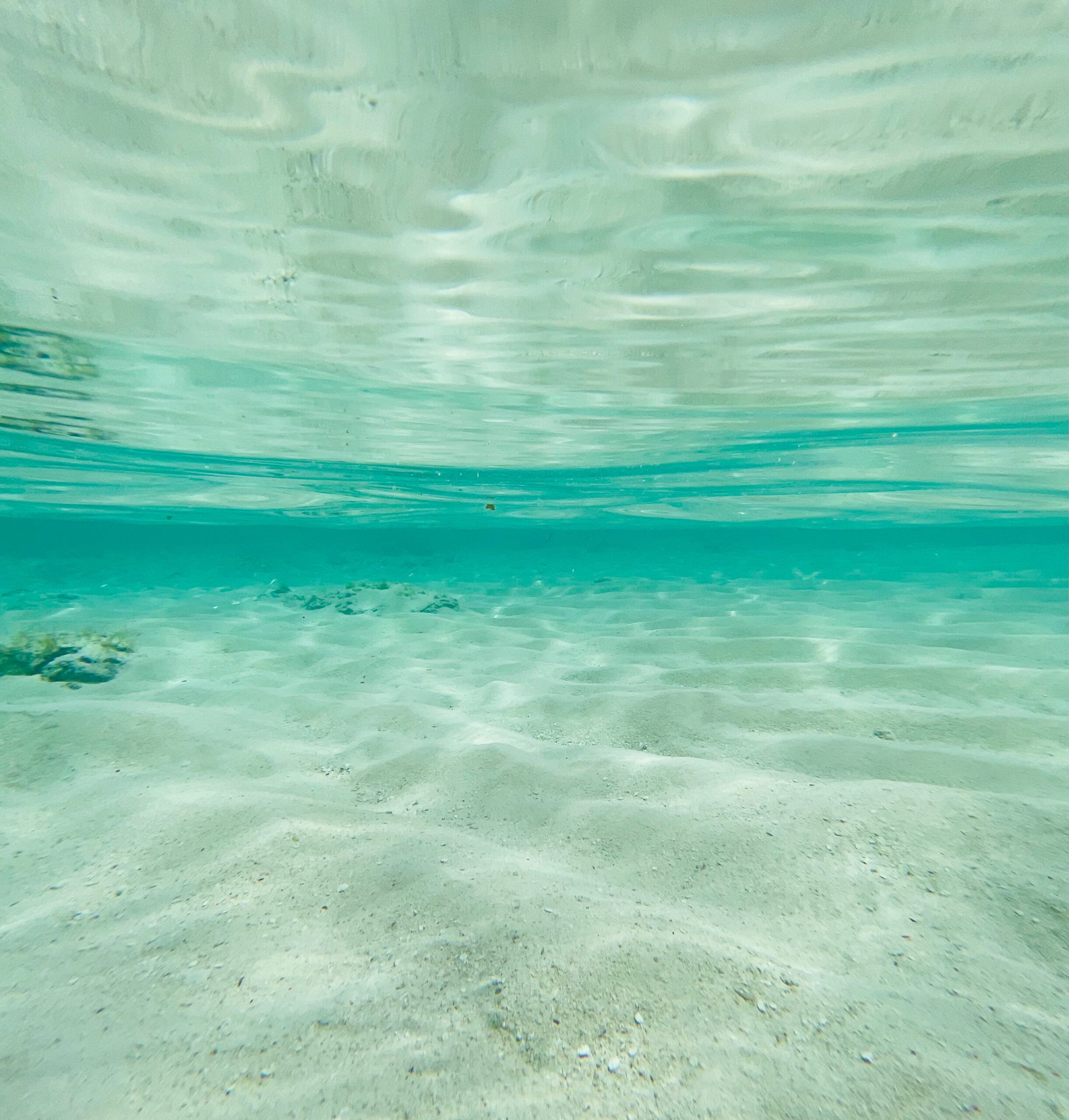
Swim over a sandy seabed and you’ll often notice something curious — the sand may be covered in rows of ripples stretching across the seafloor, creating patterns that can look almost too organised to be natural.
What’s strange is that these ripples form in an environment that seems anything but orderly. Waves arrive one after another, currents shift direction, and countless grains of sand are constantly being moved around.
So how does a seemingly chaotic ocean organise sand into such precise shapes?
How Ripples Form
The process begins with a tiny imperfection.
If one spot happens to be slightly higher than the surrounding sand — due to waves, a shell fragment, a burrowing animal, or simply chance — water moves a little differently around it.
As waves pass overhead, they push water back and forth across the seabed, rolling and lifting individual grains of sand. Some sand settles around the small bump while other grains are carried away.
As a result, the bump gradually grows.
Wave after wave repeats the process until a series of ridges and troughs emerges across the seabed. Once a ripple forms, it also influences where the next ripple develops, creating the repeating pattern seen across sandy bottoms.
In simple terms, moving water naturally sorts loose sand into organised shapes.
Why Aren’t Ripples Straight?
If waves are moving in roughly the same direction, you might expect ripple lines to be somewhat straight.
But conditions are never identical across an entire beach or seabed. Small differences in:
- Wave energy — stronger or weaker waves move sand at different rates and can alter ripple spacing and shape.
- Current strength — variations in water flow influence how sediment is transported and deposited across the seabed.
- Sand grain size — finer and coarser grains respond differently to moving water, affecting how ripples develop.
all influence how ripples grow.
These variations cause ripple lines to bend and curve rather than forming perfectly straight ridges. The pattern is organised, but never exact.
Where Ripples Form — And What They Can Tell Us
Ripples form wherever there is loose sediment and enough water movement to shift it around. They are most common on sandy beaches, shallow lagoons, tidal flats, and offshore sandy seabeds.
Some ripple fields cover only a few square metres, while others can extend for hundreds of metres across the seafloor.
The appearance of a ripple field can reveal clues about the conditions that created it:
- Small, closely spaced ripples usually form in calmer conditions.
- Larger ripples often indicate stronger waves or currents.
- More symmetrical ripples are typically created by waves moving water back and forth.
- Asymmetrical ripples often form where currents flow predominantly in one direction.
To scientists, ripple patterns are more than just scenery — they provide a snapshot of how water has been moving through an area.
Ripples Beyond the Ocean
The same basic process occurs anywhere wind or water transports loose sediment.
In deserts, wind creates ripple patterns in sand that can look remarkably similar to those found in the ocean. Although the forces involved are different, the underlying process is much the same.
Similar ripple patterns can even become buried and preserved in rock. Millions of years later, geologists can still identify these ancient ripple marks, using them as evidence of long-lost beaches, riverbeds, and shallow seas.
A Pattern Hidden in Plain Sight
Most people swim over sand ripples without giving them a second thought.
Yet those repeating ridges are evidence of something surprisingly powerful: nature’s ability to create order from countless small interactions.
Every ripple began as a tiny irregularity in the sand. Given enough moving water and enough time, those small differences grew into patterns that can stretch across entire seabeds — and, in some cases, survive for millions of years in stone.