Leopard sharks have always been one of my favourite animals, so the thought of finally seeing one in the wild had me counting down the days with pure excitement. I’d read countless stories about Julian Rocks being one of Australia’s best dive sites. Since it was technically in NSW — and I usually prefer tropical diving — I was a little skeptical at first. But it promised leopard sharks, and that was enough for me.
Safe to say, the ocean had much bigger plans for me.
Getting There
At the end of March 2025, I left the Gold Coast before dawn and headed south as the sky slowly brightened. The excitement of the dive trip ahead had made the early start easy, and by the time I reached Brunswick Heads, I couldn’t wait to get in the water.
After a quick briefing with the team at Blue Bay Divers, we boarded the boat and headed down the river toward Julian Rocks. The cool morning air, the smell of salt, and the familiar motion of the boat brought back that feeling that always comes when you leave shore behind.
As we crossed the bay, Byron Bay’s coastline stretched along the horizon. About halfway to Julian Rocks, a pod of dolphins appeared in the distance—a promising start to the day.
Once we arrived, I was first into the water after the safety briefing. The water felt cool at first but quickly became comfortable. Visibility was around 10 metres and fairly hazy—not exactly ideal conditions, but I was determined to make the most out of it.
The Nursery
The Nursery was the first site I explored, on the northern side of Julian Rocks. At around 5–10 metres deep, it was a maze of rocky reef formations surrounded by schools of curious fish.
I headed toward the shallower section and, within minutes of entering the water, finally saw it:
my first leopard shark.
I actually let out a muffled scream through my snorkel.
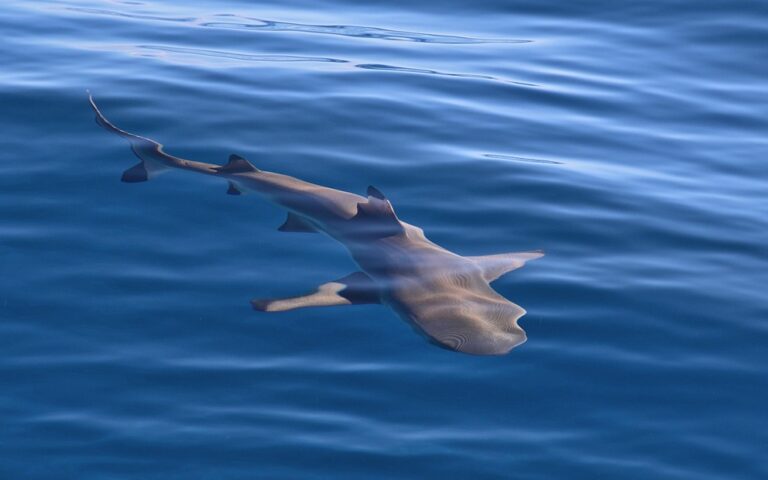
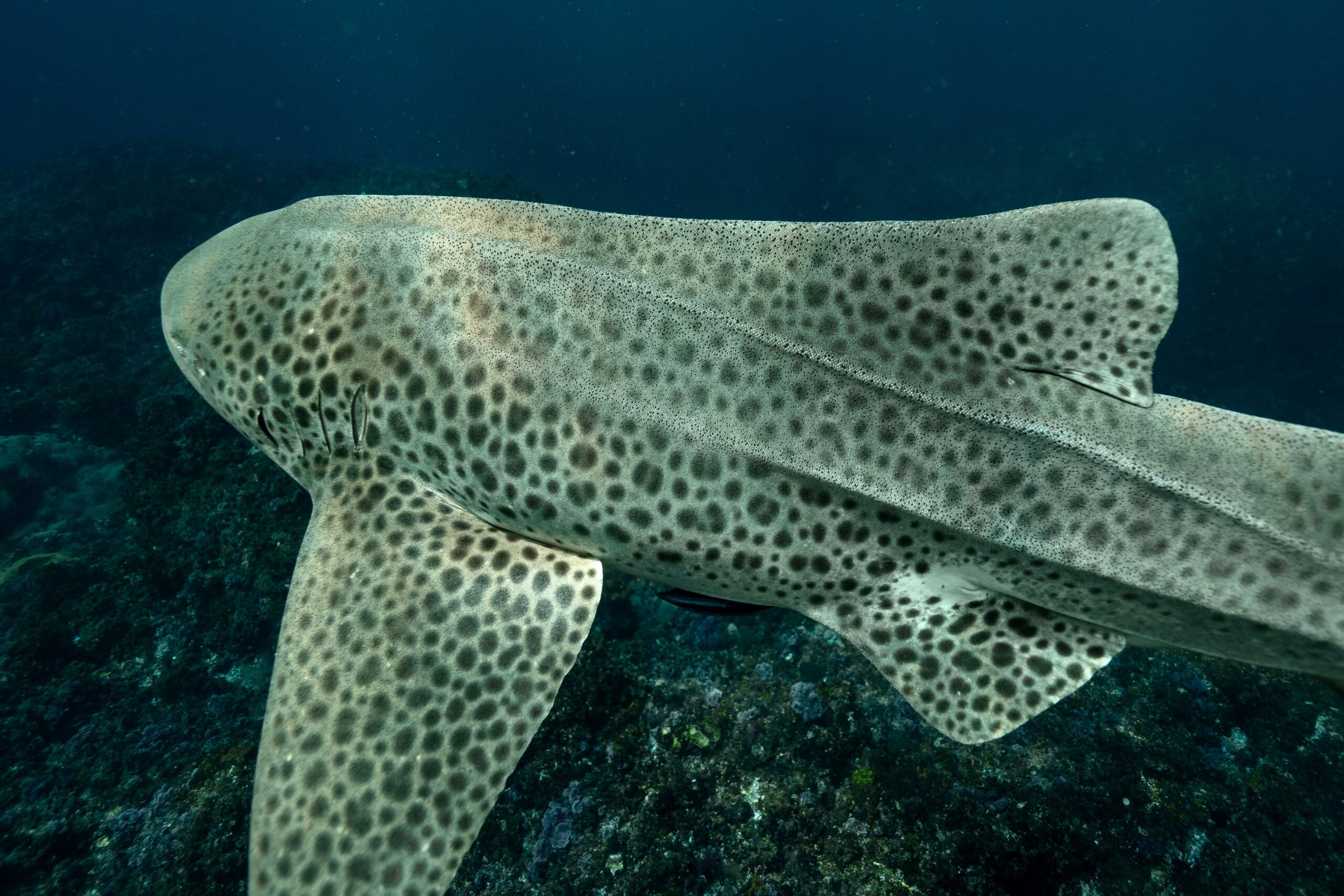
The shark cruised calmly through the shallows, completely unbothered by my excitement. Its broad head swept gently from side to side as it moved unhurriedly over the reef. Seeing an animal you’ve dreamed about for years for the first time is difficult to describe. It hardly feels real.
As I continued exploring, a white-spotted shovelnose ray glided across the reef beneath me. With the broad wings of a ray and the elongated body of a shark, they look unlike almost anything else on the reef. It passed effortlessly over a patch of sand before disappearing between the rocky outcrops.
Looking more closely at the reef below, I realised one of the oddly shaped rocks was actually a wobbegong shark. Once I saw one, I started noticing more. Some rested openly on the reef while others tucked themselves into cracks and crevices. Their camouflage is so effective that I’m sure I missed many of them hiding amongst the reef.
At the shallowest part of the site, where waves surged against the rocks, a small green sea turtle cruised along the reef edge. It seemed completely relaxed, occasionally changing direction as it followed the contours of the reef. I spent a few quiet minutes drifting with it before continuing west toward the Needles.
On the way, another leopard shark passed directly beneath me. It was a crazy moment, especially considering the water was probably only five metres deep. For a few seconds it passed directly below me, close enough to admire every intricate pattern on its back before gradually disappearing into the hazy water.
Near the edge of the Needles, I reached an area known for spotted eagle rays. Before long, four appeared over the reef at once — the largest eagle rays I’d ever seen. Watching them move is always impressive. Their bright white spots were visible long before the rest of their bodies emerged from the haze.
I returned to that same area several times throughout the day and was almost always rewarded with another sighting. Sometimes there was a single ray. Sometimes several. They would cruise over the reef, circle the area for a few minutes, then continue on their way.
The Needles
The Needles were where everything truly came alive.
The reef rose higher, the water deepened, and the current strengthened slightly as it wrapped around the edge of the island. Even so, it was comfortable to manage, and I ended up staying there for the majority of my time in the water.
Leopard sharks were everywhere.
I counted nearly a dozen during my time there, spread throughout the sandy channel between two long rock pillars. Some rested on the sand, barely moving, while others cruised through the water column.
I noticed one individual even had half its tail missing — a stark reminder of how unforgiving life can be.
After a while of hanging around the Needles, a large, dark shape suddenly materialised through the haze.
My heartbeat jumped.
At first, I couldn’t make out what it was.
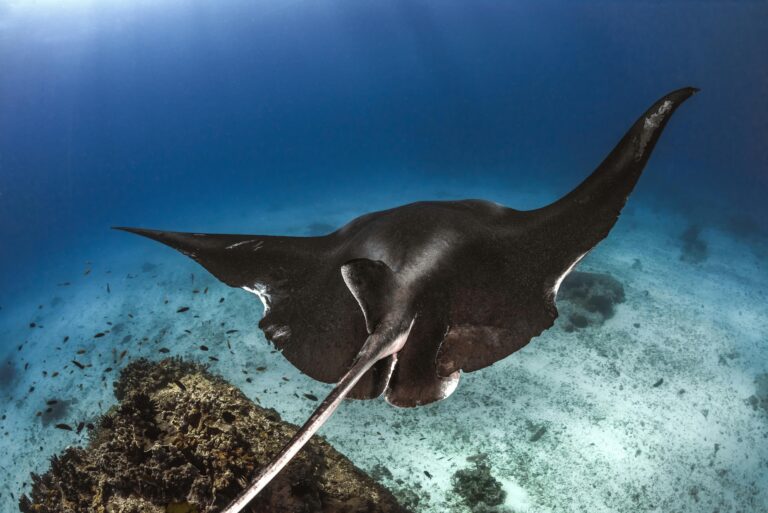
Then it emerged fully: a melanistic manta ray.
I was slack-jawed. I certainly wasn’t expecting to see one of those.
The manta moved to hover around a section of reef where the rock rose upward into the current, likely feeding as the water pushed nutrients through the area.
I stayed with it for a while, watching it circle gracefully through the water.
Then everything happened at once.
One second, there was only the manta ray. The next, an eagle ray hovered behind it, then a loggerhead turtle — the first I’d ever seen — rose up from below. While I looked down at it, a pattern in the reef caught my eye, and there was a cluster of wobbegongs — in what I affectionately call a “cuddle puddle” — lying together on the rocks.
Four incredible species, all within metres of each other — and leopard sharks in the background.
I genuinely didn’t know where to look or where to point my camera.
The encounter lasted only seconds, but it felt impossible to take it all in.
For the remainder of my time in the water, I did another lap of the dive site, even drifting past a few jellyfish before eventually heading back toward the boat.
In the deeper water, I spotted a hawksbill turtle resting practically on top of a wobbegong perched on the rocks below (it was honestly kind of hilarious — it had the whole reef to pick and yet it chose to sit on a shark). A leopard shark then swam by in the distance — one final send-off from the species I’d travelled there hoping to see.
Heading Home
By the time I got out of the water, my camera was packed with footage.
Climbing back onto the boat cold, exhausted, and buzzing with adrenaline, I felt that quiet kind of happiness only the ocean can give you — the kind that leaves you grinning for hours afterward.
The ride back to shore was reflective but full of excitement. Divers swapped stories about everything they’d seen — apparently I was the only one to see the black manta, and thank god I had the footage to prove it. I’m not sure they would’ve believed me otherwise.
But I wasn’t expecting what they told me in return.
They’d seen around a dozen female grey nurse sharks — one of them pregnant — along the south-western side of the rocks, not far from where I’d been swimming.
I was devastated to have missed them, especially since they’re high on my bucket list to see. But at the same time, I couldn’t complain after the dive I’d just had.
Besides, it gave me the perfect excuse to come back to Julian Rocks (not that I needed one).
I spent half the drive back to the Gold Coast calling family members and enthusiastically recounting every detail of the day. I’m fairly sure I spoke nonstop for half an hour straight about leopard sharks alone (sorry mum).
Key Takeaway
This trip felt special for more reasons than just the wildlife. Not only had I finally seen leopard sharks and crossed new species off my list, but the experience reignited something in me.
I’d only been diving occasionally in the years beforehand, but this trip pulled me fully back into the ocean again. It reminded me why I love snorkelling and diving so much — that sense of wonder, unpredictability, and connection that only the marine world can provide.
Julian Rocks showed me just how generous the ocean can be, and how even hazy, low-visibility conditions can produce unforgettable experiences.
Even now, the whole day feels slightly surreal when I think back on it.
Safe to say, the day exceeded every expectation.
If you want to experience Julian Rocks too, see our guide: Julian Rocks: A Local’s Guide to Snorkelling and Diving in Byron Bay