
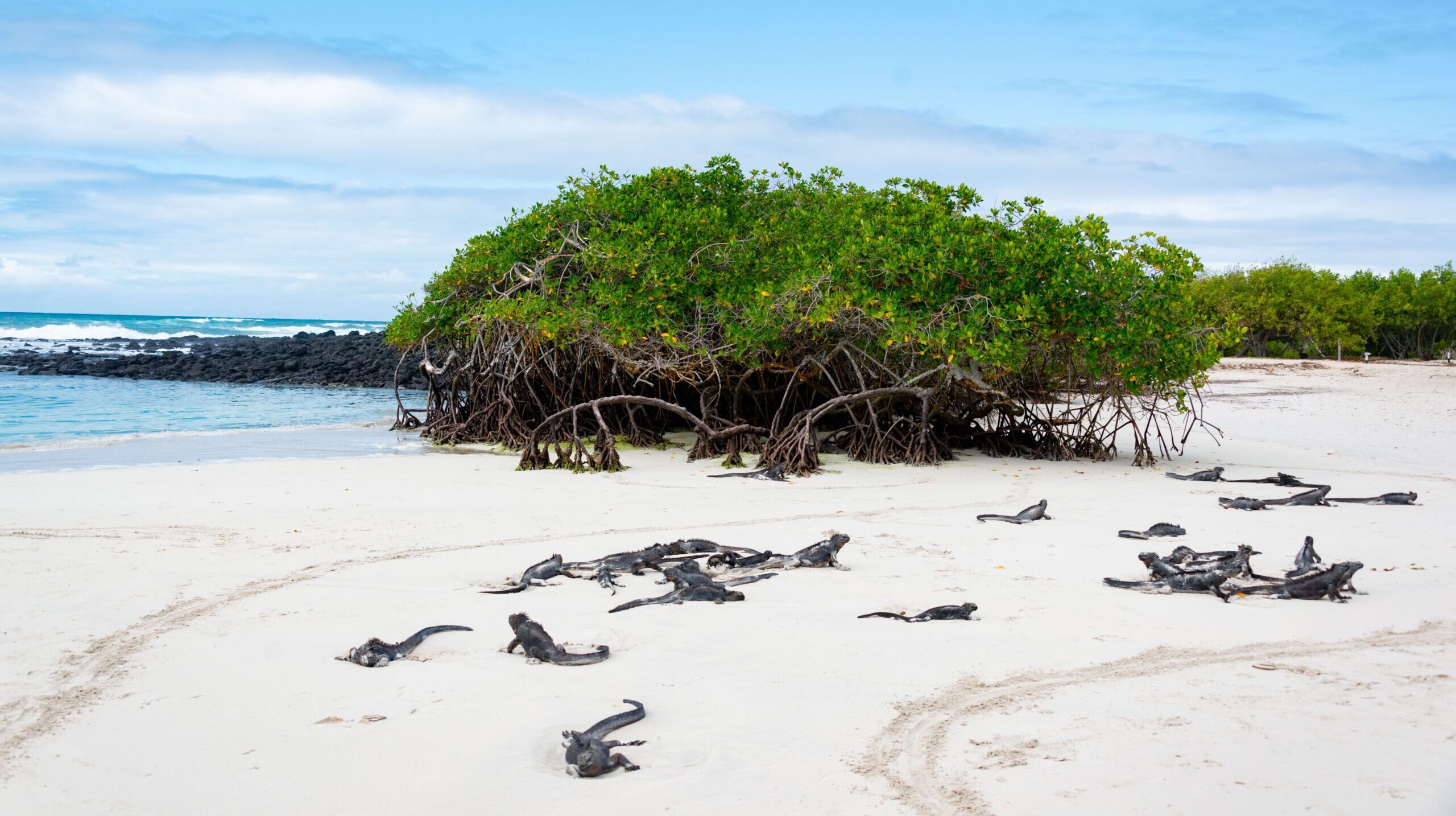
At low tide, a mangrove forest can look almost alien. Roots rise from the mud in every direction, twisting above the surface like a maze. Small fish dart through pools left behind by the retreating tide while crabs disappear into burrows beneath the trees.
It is a strange place to find a forest.
Mangroves grow where land and sea meet, in environments that can be challenging for most plants. Yet these remarkable trees thrive in places where few others can, forming forests along tropical and subtropical coastlines around the world.
What Exactly Is a Mangrove?
Mangroves are a group of trees and shrubs specially adapted to grow in salty coastal environments.
They are found in the intertidal zone — the area between high and low tide — along sheltered coastlines, estuaries, lagoons, and river mouths. Around 70 species of mangroves exist worldwide, each equipped for life at the edge of the sea.
Together, these trees form mangrove forests: unique ecosystems that connect land and ocean.

How Do Mangroves Survive in Saltwater?
Living in salty mud presents challenges that would kill most trees.
Salt can dehydrate plants, while waterlogged sediments often contain little oxygen. Mangroves overcome both problems through a range of specialised adaptations.
Some species filter out much of the salt before it enters their roots, while others remove excess salt through their leaves. To cope with oxygen-poor mud, many grow aerial roots that extend above the surface, allowing them to absorb oxygen directly from the air.
These adaptations allow mangroves to survive in places where few other trees can.
An Unusual Way to Grow
Mangroves have also evolved an unusual reproductive strategy.
Many species begin developing while still attached to the parent tree. Instead of dropping dormant seeds, they produce young plants known as propagules that continue growing before eventually falling into the water.
Some take root nearby, while others drift on tides and currents until they find a suitable place to establish themselves.

A Nursery Beneath the Roots
One of the most important roles of mangrove forests happens beneath the water.
For a juvenile fish only a few centimetres long, a mangrove forest can be the difference between life and death. Beyond the roots, larger predators patrol open water. Within them lies a maze of hiding places.
Mangrove forests provide nursery habitat for countless marine animals. Scientists estimate that roughly three-quarters of commercially caught fish species spend at least part of their lives in coastal wetlands such as mangroves, seagrass meadows, and estuaries.
Juvenile snappers, groupers, barramundi, prawns, crabs, and many other species use mangroves as a safe place to grow before moving into reefs, estuaries, or offshore waters.
What appears above the surface as a coastal forest often functions below the water as a nursery for the next generation of marine life.
More Than Just a Fish Nursery
Mangrove forests support far more than fish, including:
- Birds such as herons, egrets, kingfishers, and ospreys, which nest, roost, and hunt among the branches
- Crabs including mud crabs and fiddler crabs, which burrow through the mud and recycle nutrients
- Reptiles such as saltwater crocodiles, monitor lizards, and mangrove snakes, which use the forest for shelter and hunting grounds
- Insects that pollinate plants and provide food for countless other animals
- Mammals ranging from flying foxes to monkeys, which feed, shelter, or travel through mangrove habitats
A Food Web Built on Fallen Leaves
Even fallen leaves play an important role.
As leaves break down, they become food for bacteria, fungi, worms, and other small organisms. These creatures are then eaten by larger animals, helping fuel entire food webs throughout the forest.
Mangroves are also closely connected to neighbouring habitats such as seagrass meadows, estuaries, and coral reefs. Animals regularly move between these ecosystems, carrying energy and nutrients with them.

The Coastal Forest That Protects the Shoreline
Mangroves do more than support wildlife. They also help shape and protect coastlines.
Holding the Coast Together
Their roots slow moving water and trap sediment carried by tides and rivers. Over time, this helps stabilise shorelines and reduce erosion.
In some locations, mangroves can even help build new land by gradually trapping sediment faster than it is removed.
Natural Storm Protection
Mangrove roots and trunks absorb some of the energy from waves before it reaches the land behind them. During storms, these forests act as natural buffers, helping reduce erosion and storm damage.
Following major storms and tsunamis, researchers have often found that coastlines protected by intact mangrove forests experience less erosion than nearby areas where mangroves have been removed.

One of Nature’s Most Powerful Carbon Stores
Mangroves also play an important role in storing carbon.
Like all plants, mangroves absorb carbon dioxide from the atmosphere. Some of this carbon becomes part of the tree itself, while much of the rest is buried in the muddy sediments beneath the forest.
Because these sediments contain very little oxygen, organic material decomposes slowly. Carbon can remain locked away for centuries or even millennia.
Although mangroves cover less than 1% of the world’s tropical forest area, they store a disproportionately large amount of carbon. Per hectare, mangrove forests can store several times more carbon than many terrestrial forests.
This long-term carbon storage is known as blue carbon.
Why Mangroves Are Disappearing
Despite their importance, mangrove forests have declined in many parts of the world.
The main threats include:
- Coastal development
- Port and infrastructure construction
- Aquaculture, particularly shrimp farming
- Pollution and altered water flows
- Climate-related pressures
Scientists estimate that around one-third of the world’s mangrove forests have been lost over the last century.
The loss of mangroves can reduce nursery habitat for marine life, increase coastal erosion, and release carbon that had been stored in sediments for long periods.

A Forest Worth Looking Closer At
Mangroves rarely receive the same attention as coral reefs, whales, or sharks. They are quieter ecosystems, often hidden in muddy estuaries and sheltered bays.
Yet beneath those tangled roots lies one of the most important habitats on Earth.
They shelter young marine animals, support complex food webs, help protect coastlines, and store remarkable amounts of carbon. Remove a mangrove forest and the effects can spread far beyond the shoreline where it once stood.
The next time you pass a mangrove-lined creek or estuary, it is worth looking a little closer. What may appear to be a simple stand of coastal trees is actually an ecosystem helping hold entire coastlines together.
Explore More
skip render: ucaddon_post_carousel