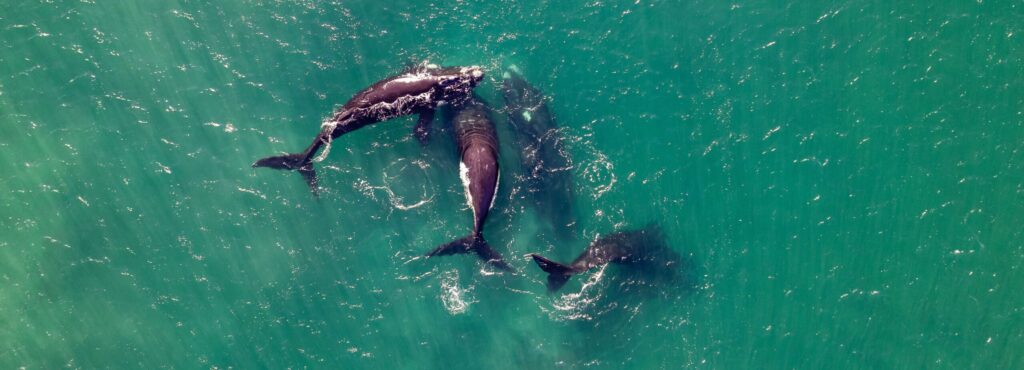


Imagine floating in the ocean when a deep, haunting sound rolls through the water beneath you. It doesn’t sound like a boat, a wave, or anything you’ve heard before. The noise rises into a series of groans, pulses, and moans before fading back into the blue.
Somewhere nearby, a whale is singing.
For decades, these sounds have fascinated scientists. Beneath those haunting notes lies one of the ocean’s most enduring mysteries.
What Is Whale Song?
Whale song is a long, structured series of sounds produced by certain whale species. Unlike simple calls used for day-to-day communication, songs follow repeating patterns that can continue for minutes or even hours.
Which Whales Sing?
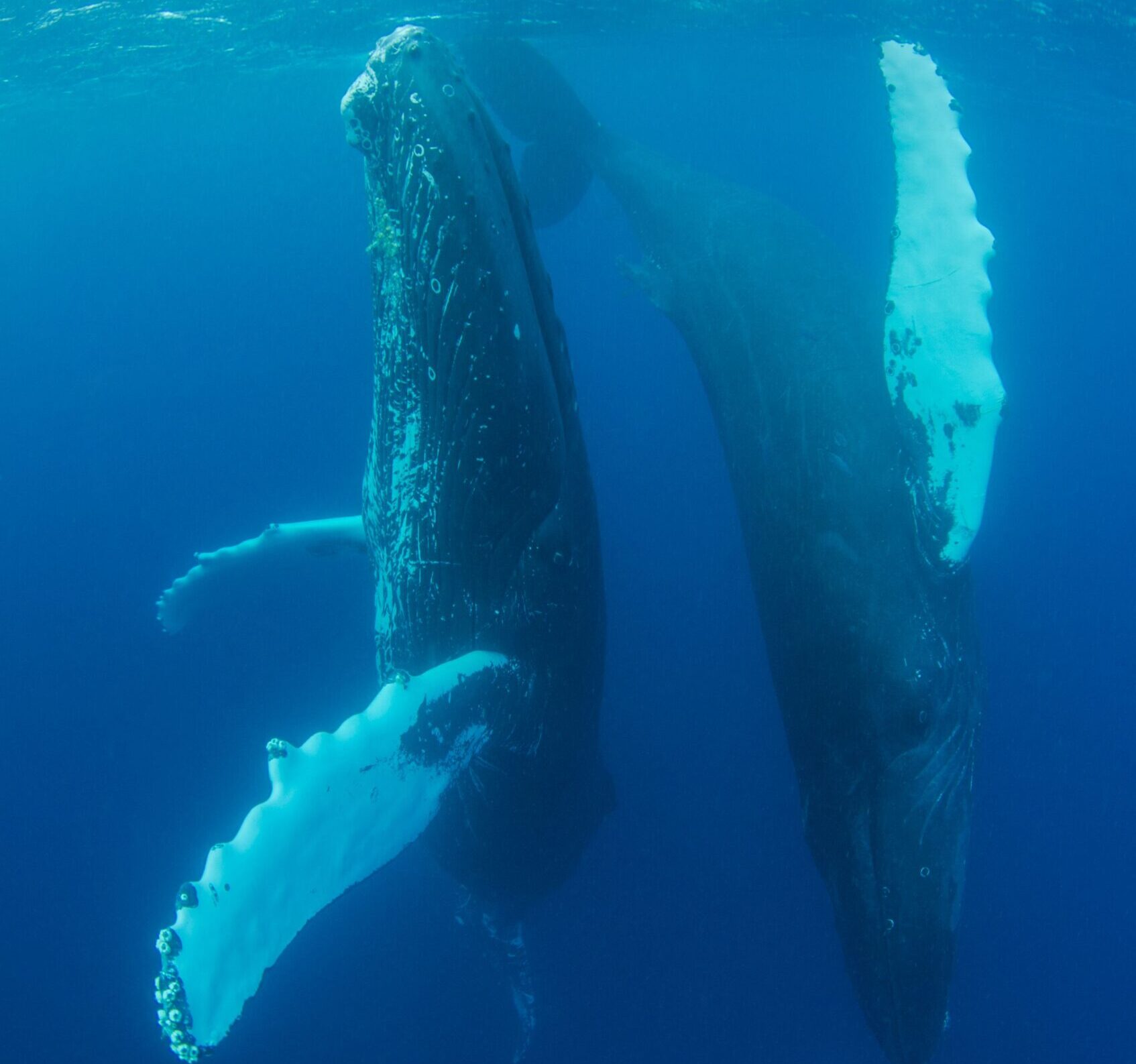
Only a handful of species are known to sing, including humpback, blue, fin, bowhead, and minke whales. All belong to a group known as baleen whales — whales that filter food from the water using comb-like plates called baleen instead of teeth.
In humpback whales, singing is primarily a male behaviour. Females communicate using calls and other vocalisations, but they do not produce the long, complex songs for which humpbacks are famous.
How Are Songs Structured?
The sounds themselves can include moans, cries, chirps, groans, and pulses. Individual sounds, known as units, are repeated to form phrases. Multiple phrases create themes, and several themes arranged in sequence form a complete song.
In some ways, the structure is similar to human language. Sounds combine into words, words combine into sentences, and sentences combine into larger conversations. Whale songs are not considered a language, but their layered organisation is one reason they continue to fascinate researchers.
Some songs can last for up to 30 minutes before repeating. Others continue for hours at a time. In one recorded session, a humpback whale sang continuously for more than 22 hours.
How Do Whales Sing?
Producing such long performances requires a unique adaptation. Rather than expelling air like humans do when speaking, whales recycle air through specialised structures in their respiratory system, allowing them to continue singing without constantly releasing air into the water.
Songs That Evolve
Perhaps the most surprising discovery about whale song is that it doesn’t stay the same.
Within a population, male humpback whales typically sing nearly identical songs. Over time, however, those songs gradually evolve. New sounds appear, old sounds disappear, and entire themes can be rearranged.
Sometimes the changes are subtle. Other times they can be dramatic, with populations adopting entirely new song patterns within just a few years.
Scientists believe whales learn these changes from one another, making whale song one of the clearest examples of culture in the animal kingdom. Rather than being born knowing a fixed song, whales appear to inherit and modify their songs through social learning.
What Are They Saying?
This is where the mystery begins.
Scientists can record whale songs, analyse their structure, and track how they change over generations. What they can’t do is translate them.
Whale songs clearly contain information. They take considerable energy to produce, other whales respond to them, and individuals can spend hours singing. Yet researchers still don’t know exactly what information is being exchanged.
Scientists can identify patterns, themes, and repeated sequences within songs, but understanding what those sounds actually mean is far more difficult. While whale songs have a structure that can be analysed and tracked over time, they have never been translated.
Are whales identifying themselves? Advertising their fitness? Communicating location? Or are the songs conveying something else entirely?
The answer remains unclear.
The uncertainty surrounding whale communication is reflected in the story of Blue 52, a whale famous for calling at around 52 hertz. Most blue and fin whales communicate at much lower frequencies, typically between 15 and 30 hertz. The unusual call earned Blue 52 a reputation as “the world’s loneliest whale,” but scientists aren’t convinced. Other whales can likely hear the calls just fine. The real mystery is how they interpret them.
Why Do Whales Sing?
After decades of research, scientists still can’t point to a single definitive answer. However, the strongest evidence suggests whale song is closely linked to reproduction.
In humpback whales, only males produce the long, complex songs for which the species is famous. They sing primarily during breeding migrations and on tropical breeding grounds, where females are present and competition between males is high.
For this reason, researchers believe whale song functions much like the courtship songs of birds. A long, complex performance may help attract females while also signalling fitness to rival males.
Singing requires time and energy, and some whales perform for hours at a stretch. One humpback was even recorded singing for more than 22 hours. Maintaining such an effort may advertise that the singer is healthy, strong, and capable of reproducing.
Yet the story may not be quite that simple.
Some scientists have proposed that songs may serve additional purposes beyond reproduction. One theory suggests whales could be using song to gather information about distant whales or features in their environment.
For now, reproduction remains the most widely accepted explanation. But like many aspects of whale behaviour, the full story is probably more complicated than it first appears.
When Humans Interrupt the Conversation
Whales rely heavily on sound to navigate their world. Unlike light, which is quickly absorbed underwater, sound travels efficiently through the ocean and can carry information across vast distances.
In fact, sound travels around four times faster in water than it does in air.
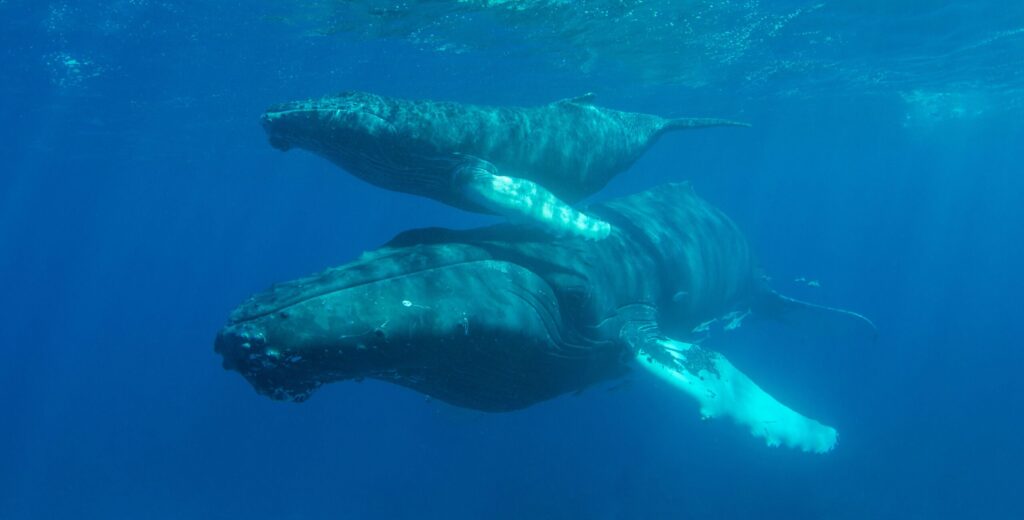
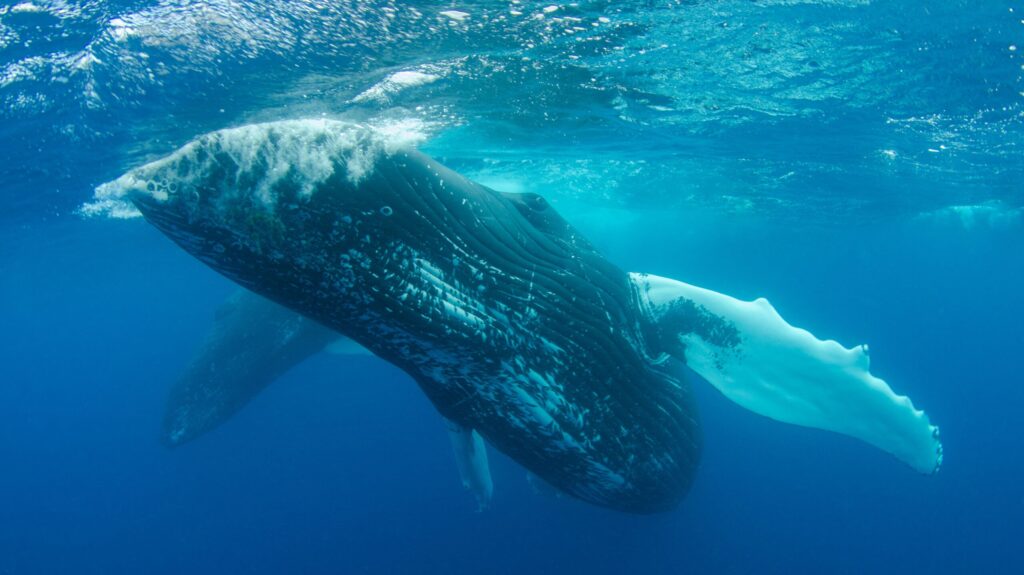
Both male and female whales also use a range of other sounds and behaviours to communicate. Calls help mothers and calves stay connected, while behaviours such as breaches, tail slaps, pectoral fin waves, and head lunges can also convey information to nearby whales.
But the oceans are becoming increasingly noisy.
Commercial shipping, naval sonar, underwater construction, and seismic surveys all add human-made noise to the marine environment. This background noise can interfere with whale communication, making it more difficult for whales to hear one another or transmit information over long distances.
Research has shown that some whales alter their vocalisations in response to noise, while others avoid areas where sound levels become too high. In some cases, whales have even reduced singing when exposed to human-generated noise from hundreds of kilometres away.
For animals that depend so heavily on sound, a noisier ocean may make life significantly more challenging.
The Ocean’s Unfinished Conversation
Somewhere in the ocean tonight, a whale is singing. What information those sounds carry remains one of the ocean’s most enduring mysteries.
Scientists have spent decades recording whale songs, analysing their structure, and searching for patterns hidden within their haunting notes. Along the way, they have discovered one of the most complex vocal displays in the natural world.
Yet despite everything we’ve learned, much of the mystery of whale song remains unexplained.