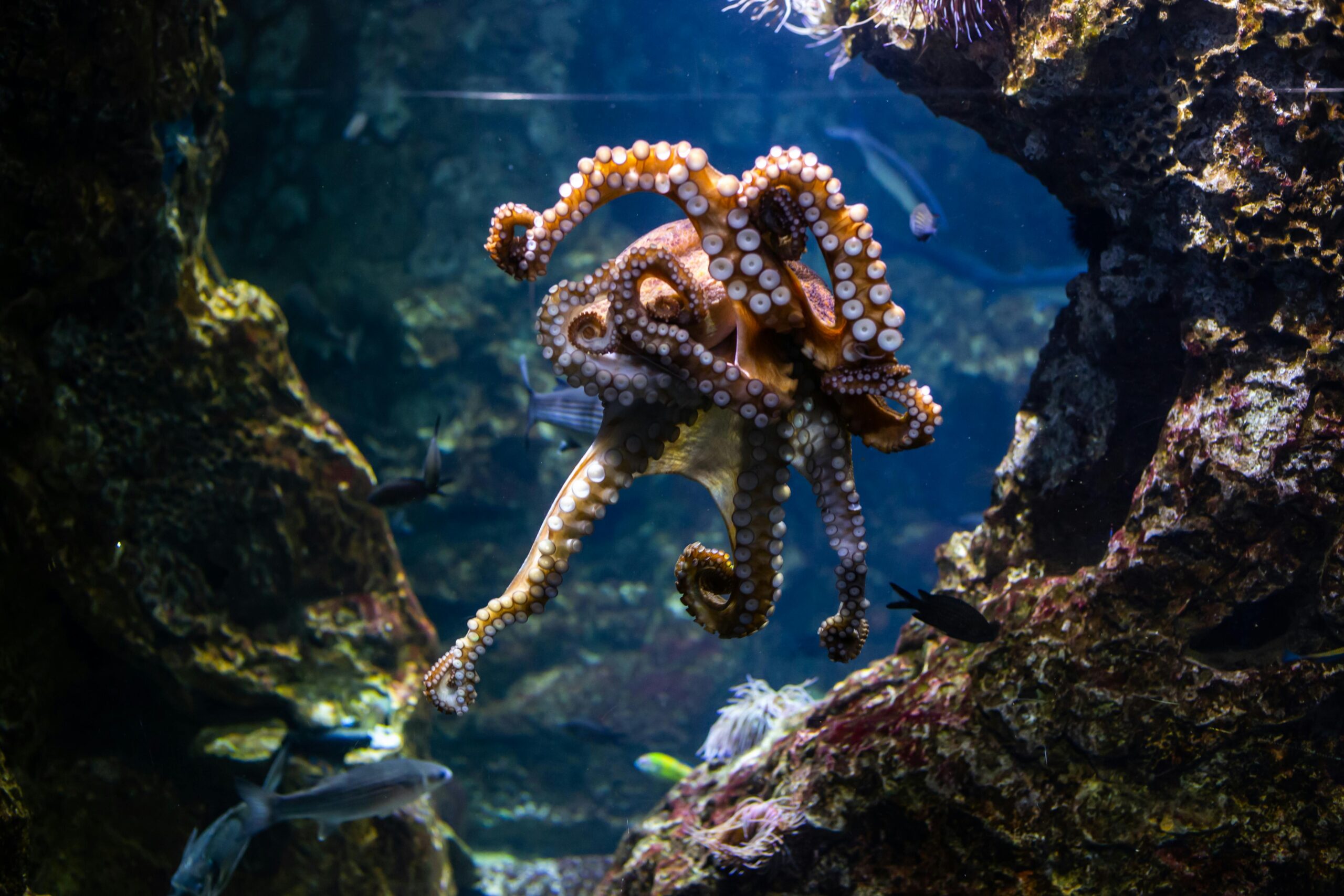
Vibrant octopus swims gracefully in Barcelona aquarium, showcasing marine life.

Why Octopuses Are Unlike Any Other Animal

Imagine you’re trapped in a locked room.

Now imagine you can slip through a gap barely wider than your eyeball, and solve the problem using eight arms that can all work at once.

For an octopus, that’s simply another day.

Found in oceans around the world, octopuses have earned a reputation as some of the strangest animals on Earth. The more scientists study them, the more unusual they become.

Eight Arms With a Mind of Their Own

Most animals control their bodies with a single, central brain. Octopuses do things differently.

Although they have a large central brain, much of their nervous system is distributed throughout their arms. Each arm can process touch, movement, and even taste on its own while still remaining connected to the brain’s overall control.

A hunting octopus might have one arm probing a crevice, another sweeping across sand, and another testing the shape of a shell — all at the same time.

Their brain-to-body ratio is also the highest of any invertebrate, a common indicator of intelligence, and exceeds that of many vertebrate animals.

Masters of Disguise

Many marine animals use camouflage, but few can match an octopus.

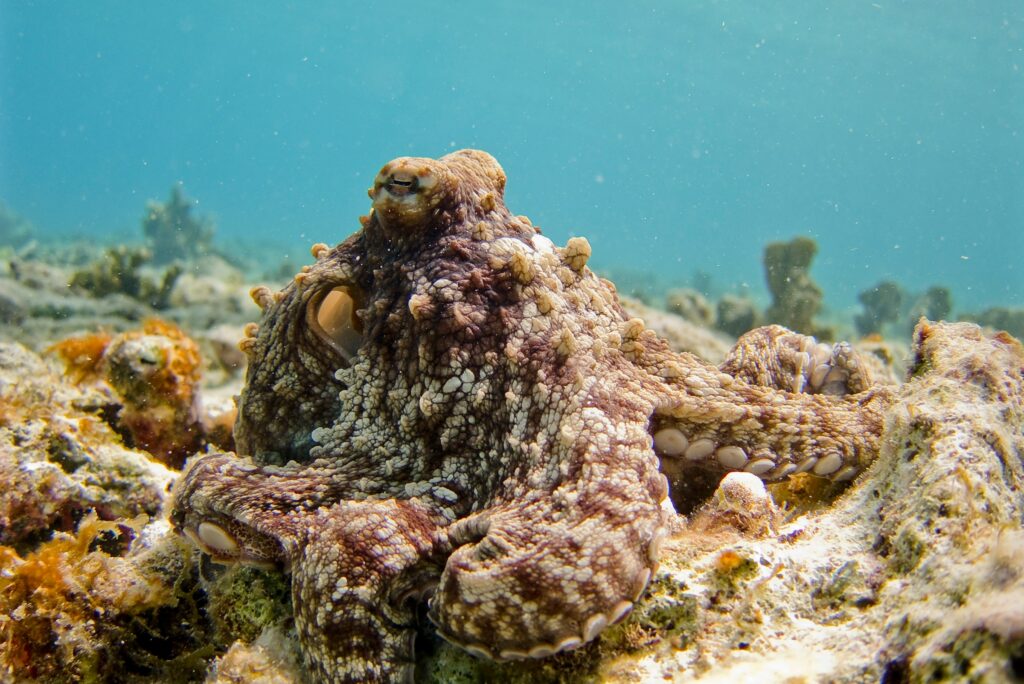
Beneath their skin lie thousands of specialised cells called chromatophores, which expand and contract to create rapid colour changes. In seconds, an octopus can shift from pale sand tones to deep reds, mottled browns, or high-contrast patterns that blend seamlessly into the reef.

They also use colour and pattern changes to communicate with one another, especially during territorial disputes or courtship.

But colour is only half the trick. Tiny structures in the skin called papillae allow an octopus to rapidly alter its texture. A smooth body can suddenly rise into bumps, ridges, and folds that mimic coral rubble, algae, or rock.

Some species can even imitate other marine animals, fanning their arms into the spiky silhouette of a lionfish or stretching into the long, ribbon-like shape of a sea snake.

Divers often swim past octopuses without realising they’re there. An animal can sit in plain sight unnoticed, only revealing itself when it moves and what looked like part of the reef suddenly comes to life.

Problem Solvers of the Sea

Octopuses are among the most intelligent animals in the ocean.

Researchers have watched them open jars, unscrew lids, navigate mazes, and solve puzzles to reach food. Some individuals even learn to recognise people and adjust their behaviour accordingly — including blasting jets of water at those they seem to take issue with.

They’re also one of the few animals known to use tools. In parts of the Indo-Pacific, octopuses have been seen collecting discarded coconut shells and carrying them across the seafloor. When threatened, they assemble the shells into a shelter and hide inside.

Researchers have also observed some octopuses handling the stinging tentacles of Portuguese man o’ wars and using them as a form of protection.

The Ultimate Escape Artist

If intelligence and camouflage aren’t enough, octopuses have another advantage: their bodies are almost entirely soft.

With no bones and only a hard beak at the centre of their body, they can squeeze through openings that seem impossibly small. If the beak fits, the rest of the octopus usually can too.

This flexibility allows them to slip through cracks in rocks, narrow pipes, and tiny holes that would stop almost any other animal. Their escape abilities have become legendary in aquariums, where octopuses have repeatedly found ways out of tanks that appeared completely secure.

Interested in watching more videos like this? Check out this fascinating YouTube Video by Mark Rober, where his octopus Sashimi conquers a maze! Click here to open in YouTube

Three Hearts and Blue Blood

Even their circulatory system is different from most animals.

Octopuses have three hearts and blue blood.

Two hearts pump blood through the gills, while a third circulates it around the rest of the body. Their blood is blue because it contains a copper-based molecule instead of the iron-based haemoglobin found in humans.

This unusual adaptation helps them transport oxygen efficiently in cold, low-oxygen marine environments.

Why Octopuses Are So Different

What makes octopuses so remarkable is that all of these abilities exist in a single animal.

An octopus can solve problems, use tools, control eight flexible arms, change both colour and texture, communicate through visual displays, and squeeze through spaces that seem impossible.

Most animals excel at one or two things. Octopuses excel at nearly everything they need to survive without claws, armour, speed, or a protective shell.

That’s what makes them feel so unlike anything else in the ocean.

Final Thoughts

The deeper scientists look, the more surprises they uncover. Every new discovery reveals another way octopuses challenge our expectations of what an animal can be.

For a creature built from softness and ingenuity, mystery seems to be part of its design.

Explore More

Scroll to Top