The Fish That Divers Fear More Than Sharks

Ask a non-diver what scares people underwater and they’ll probably say sharks.

Ask a group of experienced divers the same question and one answer is almost guaranteed to come up: the titan triggerfish.

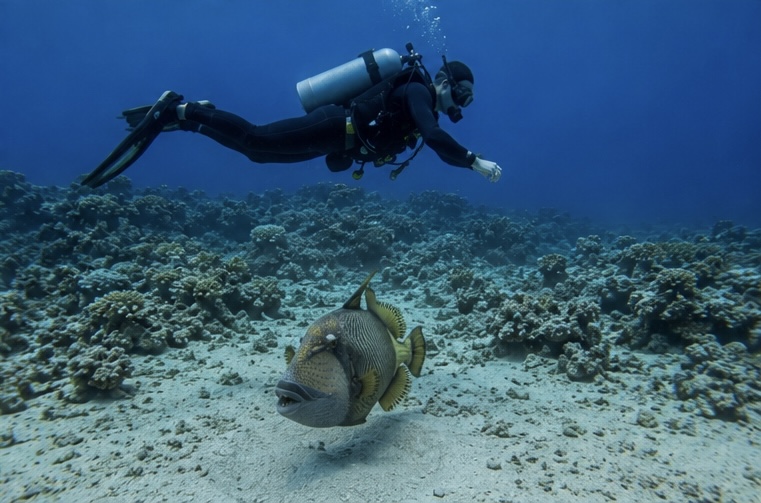
These stocky reef fish have earned a reputation for aggressively defending their nests, chasing divers, and occasionally delivering painful bites. They’re not dangerous in the same way sharks can be, but they are responsible for far more underwater panic than their size would suggest.

The Shark Myth

Sharks deserve their reputation as powerful predators, and most divers maintain a healthy respect for them.

But one of the biggest surprises for new divers is how uneventful most shark encounters are.

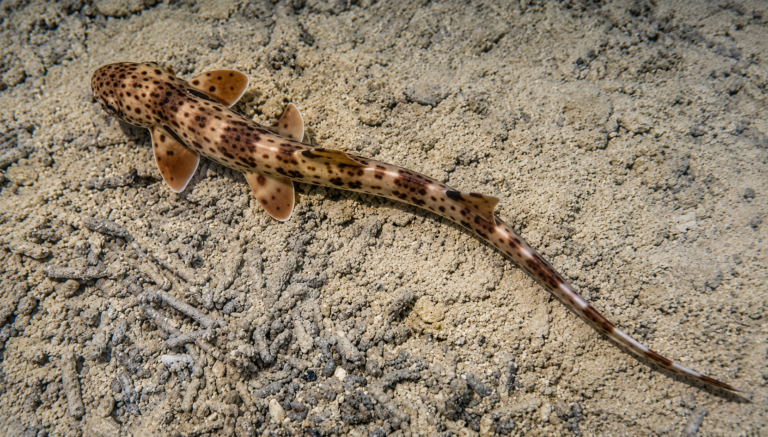
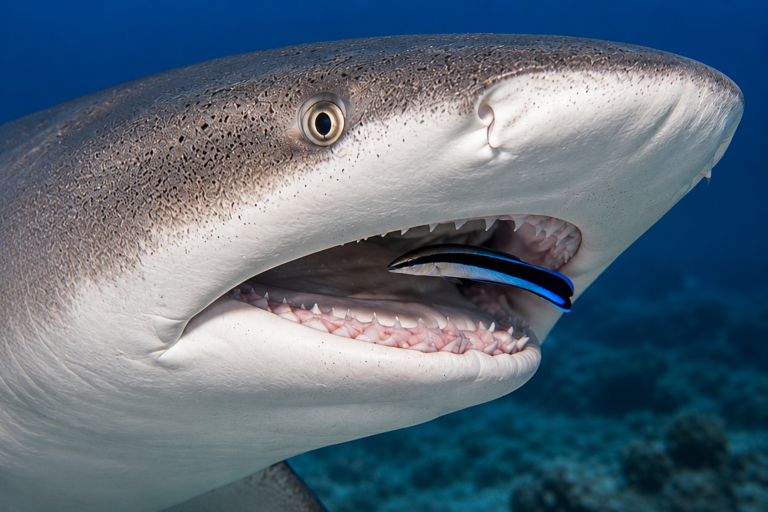
A reef shark may drift silently through the blue before disappearing into the distance. Wobbegongs often spend much of the day resting motionless on the seabed. Even larger species are usually more interested in fish, rays, or simply continuing on their way.

Many divers actively seek out shark dives, and seeing a shark is often a highlight rather than a concern. That doesn’t mean sharks should be treated casually—they are wild animals deserving of respect.

Yet when it comes to animals that are likely to actively confront a diver, titan triggerfish generate far more encounters—and far more stories—than most sharks ever do.

Meet the Titan Triggerfish

Titan triggerfish are found throughout tropical reefs of the Indo-Pacific, ranging from the Red Sea and East Africa across Southeast Asia and northern Australia to many islands in the central Pacific.

In Australia, they’re found throughout the tropical north, including the Great Barrier Reef, Coral Sea reefs, Torres Strait, and many reef systems off the Northern Territory and Western Australia. They’re particularly common on healthy coral reefs where extensive sandy areas occur between coral bommies.

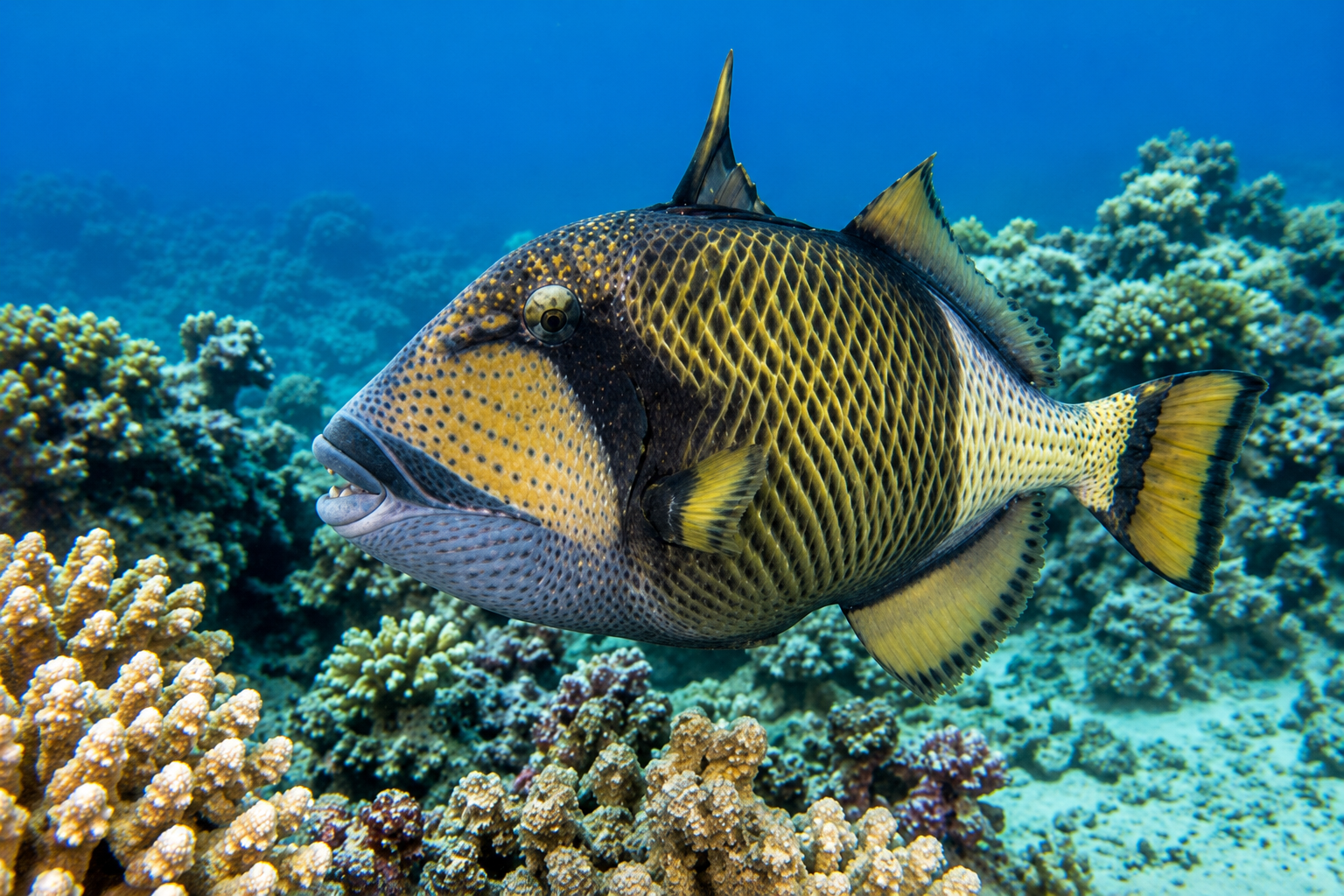
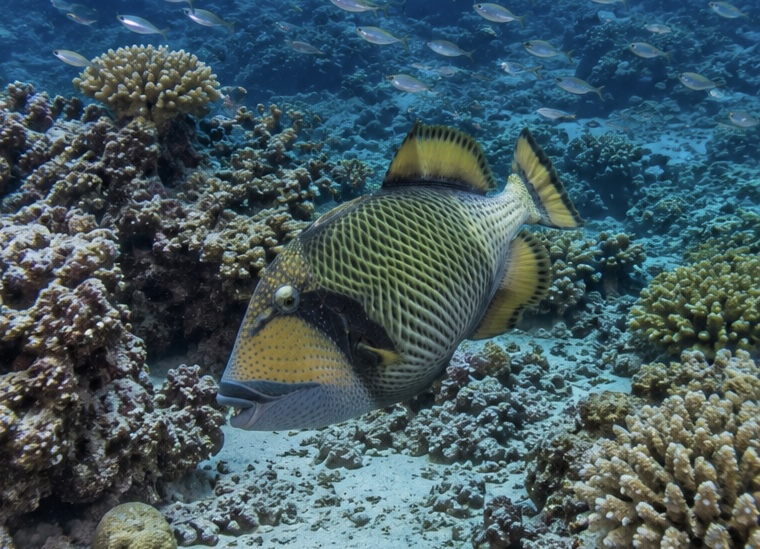
Adults can reach around 75 centimetres in length, making them the largest triggerfish species. They have a stocky, powerful build, bold facial markings, and an expression that somehow manages to look permanently annoyed.

At first glance, they don’t seem particularly intimidating.

Then you watch one casually crunch through a sea urchin like it’s a potato chip.

Built Like a Reef Bulldozer

Titan triggerfish feed on a variety of hard-shelled prey including sea urchins, crabs, molluscs, and other invertebrates.

To do this, they’ve evolved exceptionally powerful jaws and strong teeth capable of cracking, crushing, and breaking apart prey that many other fish couldn’t handle.

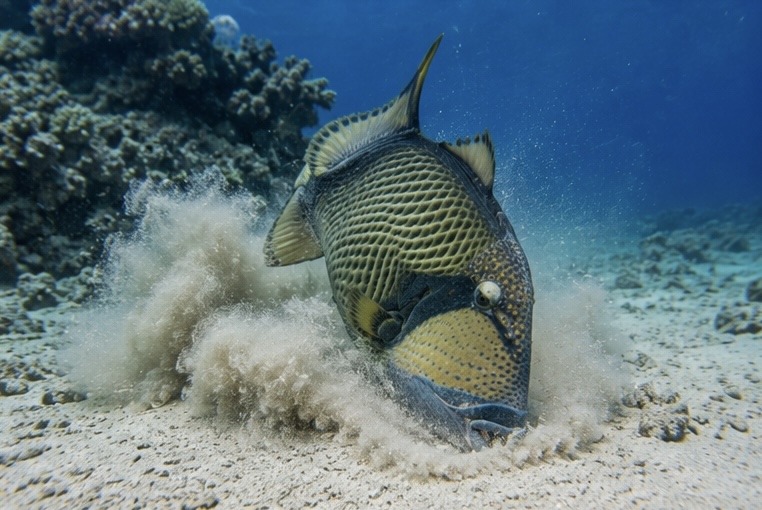
They don’t simply pick food from the reef surface. Titan triggerfish actively hunt by probing the seabed, overturning rubble, and excavating buried prey from beneath the sand. They often blast powerful jets of water into the substrate to expose hidden invertebrates before moving in to crush them.

This feeding behaviour can dramatically reshape small areas of reef. A feeding titan triggerfish may leave craters, scattered rubble, and disturbed patches of sand across the seabed as it searches for its next meal.

If reefs had construction crews, titan triggerfish would probably be operating the excavators.

The Problem Begins During Breeding Season

Most stories about titan triggerfish come from nesting season.

In tropical regions, titan triggerfish can breed during much of the year. Nesting activity often peaks during the warmer months, although the exact timing varies between locations and local environmental conditions.

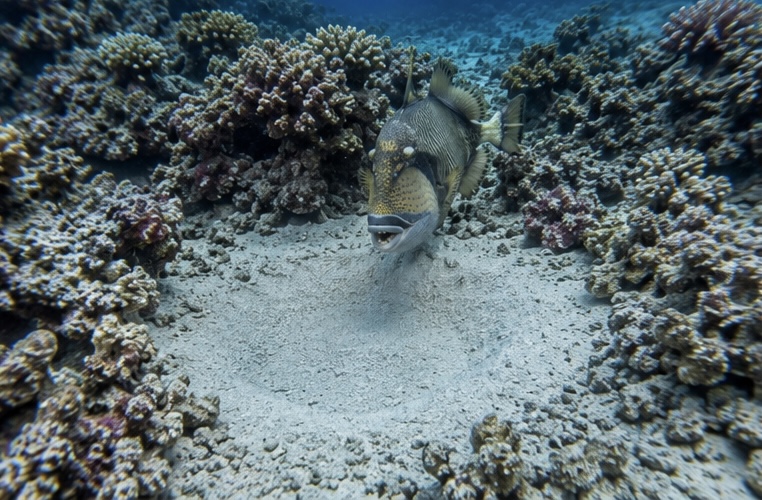
When nesting, females construct shallow bowl-shaped nests in sandy patches between coral bommies. After laying thousands of eggs, the female remains close by and aggressively guards the nest until the eggs hatch, typically within about a week.

During this short nesting period, the fish’s behaviour can change dramatically.

Almost anything entering the nesting area may be viewed as a threat.

Fish.

Turtles.

Other triggerfish.

Unsuspecting divers who have absolutely no idea they’re about to become part of a very one-sided disagreement.

It’s important to note that the fish isn’t trying to eat people or hunt them.

It simply wants every living thing near its nest to leave immediately.

Most divers go their entire lives without a negative triggerfish encounter—but nesting females can be impressively determined.

What to Look For

If a titan triggerfish is guarding a nest, it will usually advertise that fact long before making contact.

Look for:

  • A shallow circular patch of cleared sand
  • A fish repeatedly circling a particular patch of seabed
  • Sudden changes in behaviour as you approach
  • Repeated approaches toward you
  • Raised dorsal spines
  • Short, rapid charges followed by turns away
  • Persistent following after you move through an area

A calm triggerfish feeding on the reef is usually nothing to worry about.

A triggerfish that seems obsessed with your presence is trying to tell you something.

Why Divers Unintentionally Make Things Worse

Titan triggerfish often defend their nests in an inverted cone-shaped territory.

The nest sits at the narrow point on the seabed, while the defended area widens as it extends upward through the water column. Imagine an upside-down ice cream cone with its tip buried in the sand and its open end stretching toward the surface.

Depending on the fish and the location, this territory may extend several metres above the nest and become surprisingly wide near the top.

A diver hovering five metres above a nest may still be inside the defended territory without realising it.

This creates a problem.

When a diver notices an angry triggerfish approaching, the instinctive response is often to swim upward.

Unfortunately, that can keep the diver inside the triggerfish’s territory for longer.

Swimming horizontally away from the nest is usually the fastest way to leave the defended area and end the encounter.

Yes, They Really Do Chase People

Divers have reported titan triggerfish charging, circling, and pursuing them across sections of reef. Most encounters end once the diver leaves the nesting territory, but the fish’s determination is what has made it legendary among tropical divers.

It’s difficult not to admire the confidence.

Imagine chasing an animal hundreds of times your size because it wandered too close to your front yard.

That’s essentially what a nesting titan triggerfish does.

Are They Actually Dangerous?

Despite their reputation, titan triggerfish are not among the ocean’s most dangerous animals.

However, they can cause injuries.

Their bites are powerful enough to break skin and cause significant cuts or puncture wounds. Divers have been bitten on legs, arms, hands, and other exposed areas after getting too close to nests.

Most injuries are not serious, but they can be painful and occasionally require medical treatment.

Fortunately, most encounters end with the diver retreating before things escalate further.

The triggerfish gets what it wants.

The diver gets a story.

Everyone moves on.

How to Avoid Angering a Titan Triggerfish

The easiest way to avoid problems is simply to give them space.

If you notice a triggerfish behaving unusually, repeatedly circling, or swimming directly toward you, there’s a good chance a nest is nearby.

Avoid hovering over sandy patches on the reef and pay attention to warning behaviours.

If a triggerfish starts charging, remain calm and swim horizontally away from the area rather than ascending directly upward.

Most encounters end surprisingly quickly once you’re outside the defended territory.

Why Divers Respect Them

The reason titan triggerfish have become legendary among divers isn’t because they’re monsters.

It’s because they’re incredibly effective parents.

Divers don’t respect titan triggerfish because they’re large or dangerous.

They respect them because few reef animals show such complete and unwavering commitment to defending their offspring.

Every charge, warning display, and pursuit is driven by a simple goal: protecting their eggs.

A triggerfish defending a nest is evidence that reproduction is occurring, reefs are functioning, and the ecosystem is healthy enough to support another generation of marine life.

It just happens to be a little inconvenient for passing divers.

The Real Lesson

The ocean is full of surprises.

Sometimes the animals people fear most turn out to be calm, cautious, and uninterested in confrontation.

And sometimes the animal that sends divers swimming away in a hurry is a fish the size of a carry-on suitcase.

A nesting titan triggerfish may be one of the few animals on a coral reef utterly convinced it can win a fight—and determined to prove it.

So if you ever hear divers swapping stories about their most intimidating underwater encounter, don’t be surprised if the conversation isn’t about sharks.

It might be about a titan triggerfish.

Explore More

Scroll to Top