The Immortal Jellyfish: Nature’s Age-Reversing Animal

Imagine growing old, then suddenly becoming young again.

Not just looking younger, but actually reversing your life cycle and returning to an earlier stage of life.

It sounds like science fiction, yet one tiny jellyfish can do something remarkably similar. Known as the immortal jellyfish, this species has become famous for its unusual ability to effectively reset its biological clock.

But is it truly immortal?

Meet the Immortal Jellyfish

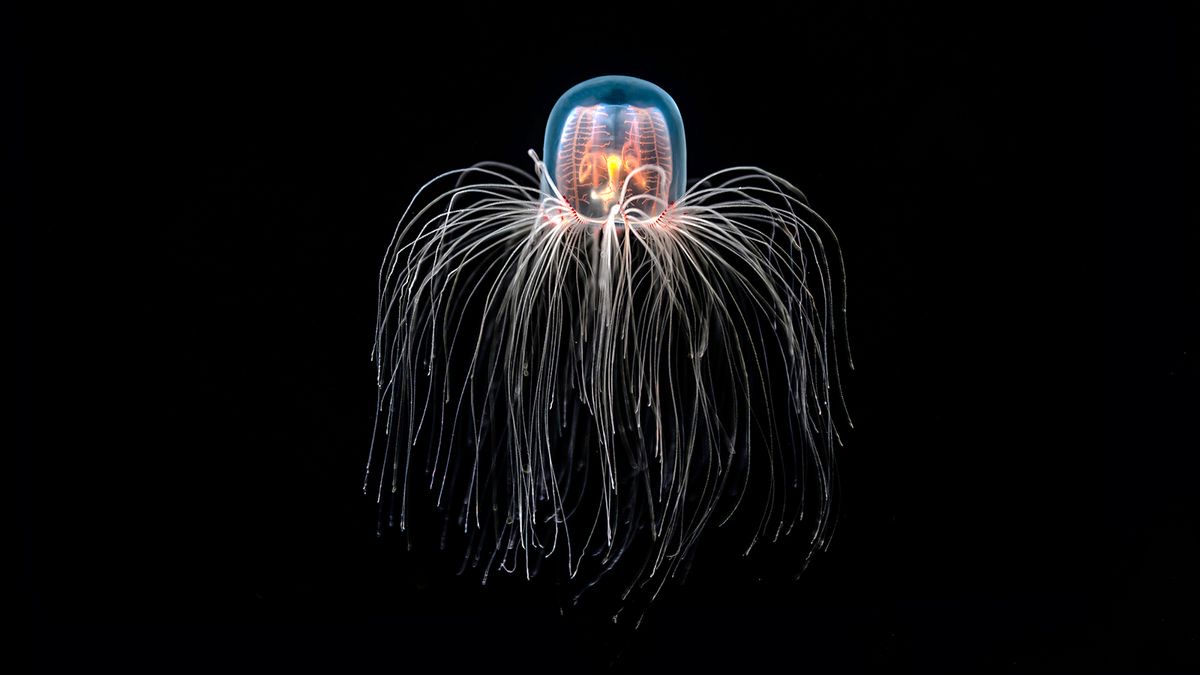
The immortal jellyfish, Turritopsis dohrnii, is a tiny species found in oceans around the world, usually measuring less than 5 millimetres across.

Like many jellyfish, it begins life as a larva before developing into a colony of tiny polyps. These polyps produce free-swimming adult jellyfish known as medusae.

For most jellyfish, this life cycle moves in one direction. The immortal jellyfish is unusual because it can reverse the process.

In fact, it is currently the only known animal capable of repeatedly reversing its life cycle from a mature adult back into an earlier developmental stage.

The Ability to Start Over

When faced with severe stress, injury, starvation, sudden changes in temperature, or other threats, the immortal jellyfish can reverse its development.

Instead of continuing to age, the adult jellyfish transforms back into a polyp-like stage.

The process begins when the jellyfish sinks to the seafloor and its body collapses into a small mass of tissue. Over time, that tissue reorganises itself and develops into a new polyp colony.

From that colony, new jellyfish can eventually bud off and begin the cycle again.

Scientists first recognised this unusual ability in the 1990s when researchers observed adult jellyfish reverting to their polyp stage in laboratory conditions.

How Does It Do This?

The secret lies in a process called transdifferentiation.

In most animals, specialised cells remain locked into specific roles. In the immortal jellyfish, some cells can change from one type into another, allowing the animal to reorganise its body and return to an earlier stage of life.

Scientists are still studying the process, but it is one of the most remarkable examples of biological reprogramming found in nature.

So Is It Actually Immortal?

Not quite.

The immortal jellyfish can avoid death from ageing, but it cannot avoid death entirely.

It can still be:

  • Eaten by predators
  • Killed by disease
  • Damaged by pollution
  • Destroyed by environmental changes
  • Injured beyond its ability to recover

In theory, if an immortal jellyfish avoided all of these threats, it could potentially continue repeating its life cycle indefinitely. No natural limit to the number of times it can reset itself has yet been identified.

In reality, life in the ocean is dangerous. Most immortal jellyfish are likely eaten or killed by other causes long before they have the opportunity to repeat the process many times.

Why Scientists Are Interested

The immortal jellyfish has attracted attention because of what it may reveal about ageing and regeneration.

By studying how its cells can effectively reset and rebuild the body, researchers hope to better understand tissue repair, stem cells, and the biological processes involved in ageing.

While this does not mean humans will one day become immortal, the species provides a rare glimpse into mechanisms that are largely absent in most other animals.

Escaping Ageing

Every living thing eventually dies. The immortal jellyfish is remarkable not because it has escaped death, but because it appears to have found a way to repeatedly escape ageing.

While most animals travel through life in a single direction—from birth to adulthood and eventually death—the immortal jellyfish can, under the right circumstances, turn around and begin the journey again.

For a creature smaller than a fingernail, that may be one of the most extraordinary biological tricks on Earth.

Explore More

Scroll to Top