Swimming with whales is one of those ideas that lives in your imagination long before it becomes real. You picture the blue, the quiet, the moment a huge shape rises out of nowhere. You don’t picture the logistics — the rushing, the crowding, the cold, the choreography of trying to keep a bunch of strangers moving as one in the open ocean.
I certainly hadn’t thought about any of that. I’d only pictured the whale, and if we were lucky, a calf.
But the day I went swimming with whales on the Sunshine Coast had a way of pulling me out of the fantasy and into the reality.
A Jet Ski That Shouldn’t Have Been There
The ride out was calm — winter sun, a light breeze, a steady offshore roll. People were scanning the surface, trying to be the first to spot something promising.
We didn’t have to wait long. A pair of whales — a mother and calf — were spotted not far ahead. There was this brief, excited shift on the boat as everyone straightened up, trying to catch a glimpse.
But as we got closer, the mood changed.
Instead of a peaceful scene, a couple on a jet ski were hovering directly above the whales with the engine running. They were far too close, ignoring every guideline, and the mother’s behaviour made it obvious she was trying to avoid them.
Each time she shifted away, they followed.
Our boat went quiet — the uncomfortable kind of silence where everyone knows they’re watching something wrong, but there’s nothing to do except wait for it to stop.
When the jet ski finally left, the mother and calf moved off quickly.
Getting In: Crowded, Rushed, and Already Wearing Thin
Once the jet ski cleared out, our skipper repositioned the boat and we started gearing up. There were 14 of us plus one guide.
The sides of the boat felt cramped with everyone sitting there in fins, anxiously waiting to be given the all-clear to jump in. The neoprene smell, the chatter, the scrape of fins — it all had this restless edge to it.
The plan was simple enough: drop in fast, stay tight, and move quickly toward the whales’ path. The guide kept reminding us not to splash, but the moment people hit the water, the splashing started anyway.
That first entry wasn’t graceful. It felt like being dropped into a floating crowd competing for space. People bumping into you, someone kicking you in the face, arms flailing in every direction, someone stopping suddenly in front of you.
It made the whole thing feel tense and clumsy rather than calm or magical. I found it hard to truly ground myself in the experience with everything going on around me.
Each attempt to see the whales blurred into the next: a long swim out, a long swim back, everyone hauling themselves up the ladder, the quick shuffle to reset. The pace never really eased. We were always being told to move, stay close, and get ready — and the group’s energy reflected it.
After several failed attempts, the crew suggested giving the whales a break. Later, when we tried again, that’s when we finally got the moment everyone had been hoping for.
The Moment That Should Have Been Magical
When we landed in the whales’ path, they turned away and everything softened for a moment.
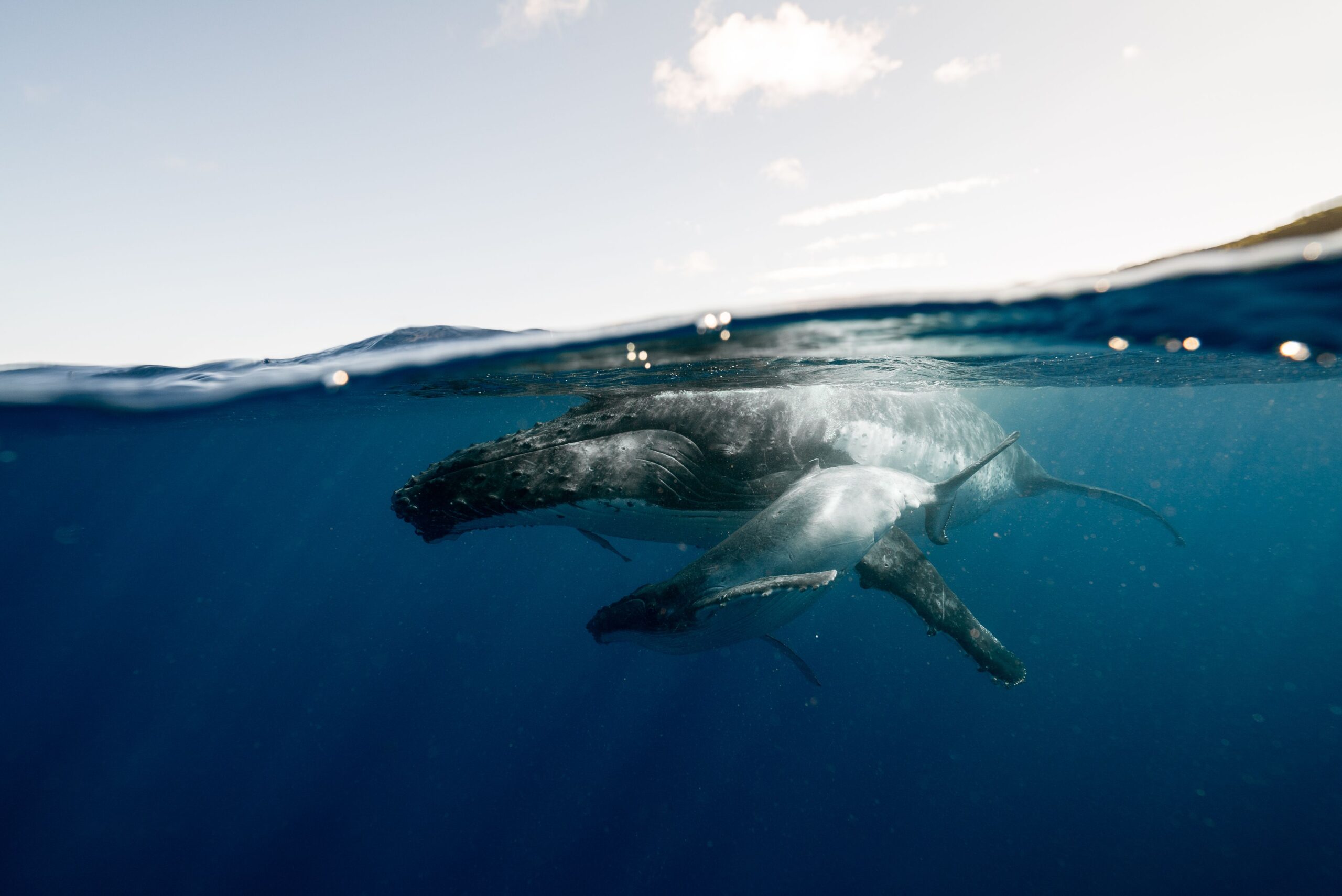
The mother and calf’s white bellies caught the light as they shifted direction. Even through the hazy blue, their size was unmistakable.
Seeing a whale from a boat is impressive. Seeing one underwater feels entirely different. There are no reference points, no horizon, nothing familiar to compare it to. Just an animal so large it seems to belong to another world.
The mother was enormous — the kind of scale you can’t truly grasp until you’re in the water with her. Every movement felt slow and deliberate, as though she existed on a different timescale to everything around her.
The calf was smaller and shy, staying close to its mum. At one point it even rested on her nose. It was adorable.
Then the mother hovered with her tail facing us, holding that position long enough for everyone to take in her size. Seeing her suspended there, perfectly still except for the slow movement of water around her, was surreal. Despite her size, there was almost no sound. No dramatic splash, no rush of water — just a silent presence hanging in the blue.
But even in that moment, I felt torn.
Part of me was in awe. The other part was painfully aware of the chaos around me. Someone’s flailing arms kept blocking my view, and they kept inching forward, unintentionally pulling others with them until the group started getting too close. The guide would tell people to move back, but many were captivated by the giant beauty in front of them.
I ended up stretching downward instead of forward just to get people out of my frame — not easy in a buoyant wetsuit with no weight belt and no room to manoeuvre.
It was frustrating, but more than that, it made me realise I wasn’t fully present. I’d imagined this moment for years, yet most of my attention was spent navigating the people around me rather than the whales themselves.
Leaving With an Icky Feeling
By the end of the tour, I felt a bit icky about the whole thing.
The whales were incredible, but the crowding, the rushing, and the general lack of awareness around me made it difficult to enjoy the brief moment we actually had with them.
And it left me questioning the ethics of the encounter — particularly because the mother and calf spent much of the day moving away from boats and swimmers.
The Ethics: Balancing Desire and Responsibility
The more I thought about the day afterwards, the more complicated it became. What started as an experience I’d been excited about for years left me wrestling with questions I hadn’t expected to ask.
For Tour Operators
From where I stood, it felt like operators are constantly juggling competing pressures. They don’t want to disappoint guests, especially when people have built the experience up in their minds. Regulations can guide behaviour, but they can’t control how individuals act once they’re in the water. And pausing or ending an encounter — even when it’s clearly the right thing for the animal — is rarely popular.
Watching the crew navigate all of that made me realise how tricky their job actually is.
For Tourists
And then there’s the tourist side — including me.
Most people arrive with genuine excitement and good intentions, but that comes with its own pressures. Many have travelled a long way or spent significant money for the experience. For some, it’s a once-in-a-lifetime trip. And the desire for a memorable moment can easily overshadow awareness of the animal’s comfort.
Standing in the water, I could see how quickly excitement took over. People weren’t trying to do the wrong thing — they just wanted a better view, a better photo, or a closer look. But when one person moved forward, others followed, and suddenly the group was closer than it was meant to be.
It wasn’t malicious. It was human.
The Core Issue
Everyone wants the same thing: a meaningful encounter that doesn’t harm the animals.
But desire and responsibility don’t always line up neatly. Regulations help, but they don’t guarantee an ethical experience. And sometimes, even when everyone is trying to do the right thing, the animals simply don’t want us there.
It made me wonder where a wildlife encounter ends and disturbance begins.
Final Thoughts
I’m glad I went — seeing whales underwater is something I’ll never forget — but the experience shifted something in me. It showed me how fragile these encounters are, how quickly they can tip from magical to messy, and how easily human excitement can overshadow the needs of the animals.
If anything, it made me more conscious of how we show up in wild spaces.
The ocean doesn’t owe us a moment. And perhaps the most ethical wildlife encounters aren’t the ones we chase, but the ones animals choose to give us.