sea, ocean, beach, aerial view, nature, summer, vacation, travel, outdoors, aerial photography

How Do You Protect Part of an Ocean?

The ocean is constantly moving.

Fish migrate, larvae drift with the currents, and ecosystems stretch far beyond what we can see from the surface.

So how do you protect part of an ecosystem that never stops shifting?

One of the most widely used ways to protect ocean ecosystems is the marine protected area, or MPA.

Marine Protected Areas: The Most Common Tool We Have

Marine protected areas are places where certain human activities are limited or managed to reduce pressure on marine life.

They exist because many coastal and offshore ecosystems face growing pressure from overfishing, habitat loss, pollution, and climate change. Some areas need space to recover, while others protect habitats and species that are particularly important to the health of the wider ecosystem.

MPAs are typically established using scientific assessments of biodiversity, habitat value, and species movement. Governments then create zoning rules that determine what activities can and cannot occur within those boundaries.

Today, more than 18,000 marine protected areas exist worldwide, covering roughly 8% of the global ocean.

At first glance, that sounds like a large area. However, only around 3% of the global ocean is currently covered by fully or highly protected marine reserves where activities such as fishing and resource extraction are largely prohibited.

In other words, much of the ocean classified as “protected” still allows some level of human use, which is why the quality of protection often matters just as much as the quantity.

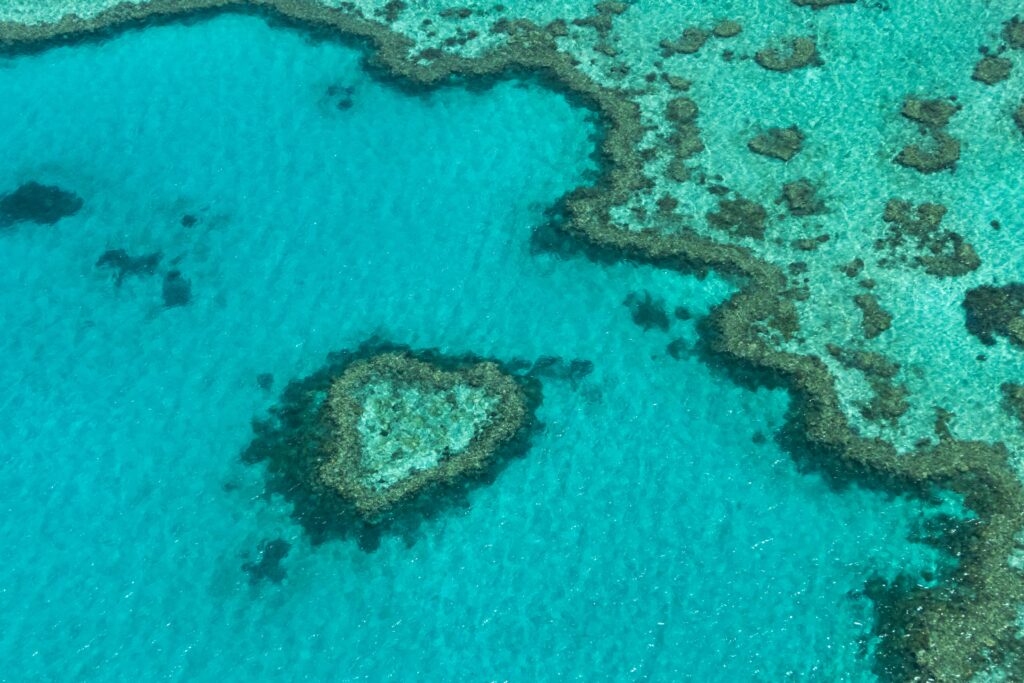
Stunning aerial shot of the heart-shaped coral formation in the Great Barrier Reef, Australia.

What It Means to Protect an Ocean Area

Many people imagine MPAs as places where all human activity is banned.

In reality, they exist on a spectrum of protection. Some areas are highly protected, while others allow sustainable fishing, tourism, research, or cultural activities.

This flexibility is one reason MPAs have become such a widely used conservation tool. They can protect important ecosystems while still supporting communities that depend on the ocean.

Types of Marine Protection Zones

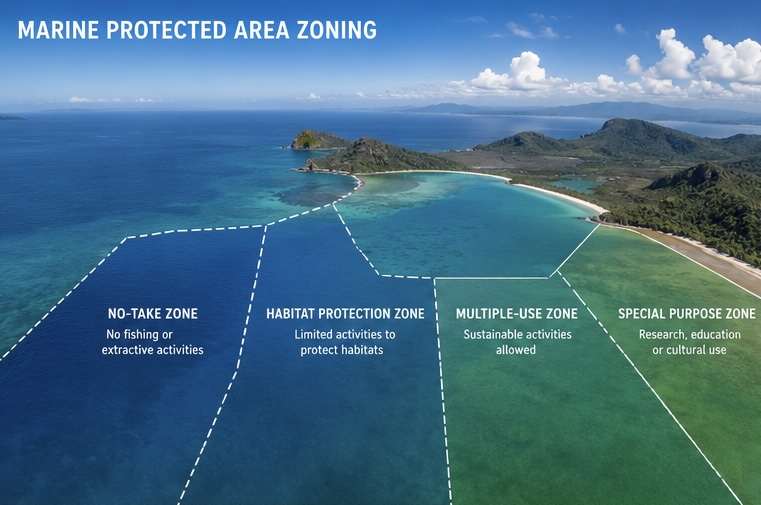
MPAs are designed to match the needs of the ecosystem. Different zones offer different levels of protection.

No-Take Zones

These provide the highest level of protection.

Fishing, collecting marine life, and resource extraction are prohibited. By removing these pressures, marine life has an opportunity to survive longer, grow larger, and reproduce more successfully.

Habitat Protection Zones

These zones focus on protecting sensitive habitats.

Activities that damage the seafloor or important ecosystems may be restricted, such as trawling over seagrass meadows, anchoring on coral reefs, or dredging near mangroves.

Special Purpose Zones

Some areas are designed to protect specific species, habitats, or ecological processes.

Examples include whale migration corridors, turtle nesting areas, and long-term scientific research sites.

Multiple-Use Zones

These zones allow sustainable human activities alongside conservation.

Tourism, recreational fishing, traditional cultural harvesting, and other low-impact activities may be permitted under specific rules.

This range of zoning means MPAs can protect ecosystems without stopping all social and economic activity.

How MPAs Protect the Ocean

MPAs work by reducing stress on marine ecosystems.

When fishing pressure eases, fish survive longer and grow larger. Larger fish often produce far more offspring than younger fish, helping populations rebuild over time.

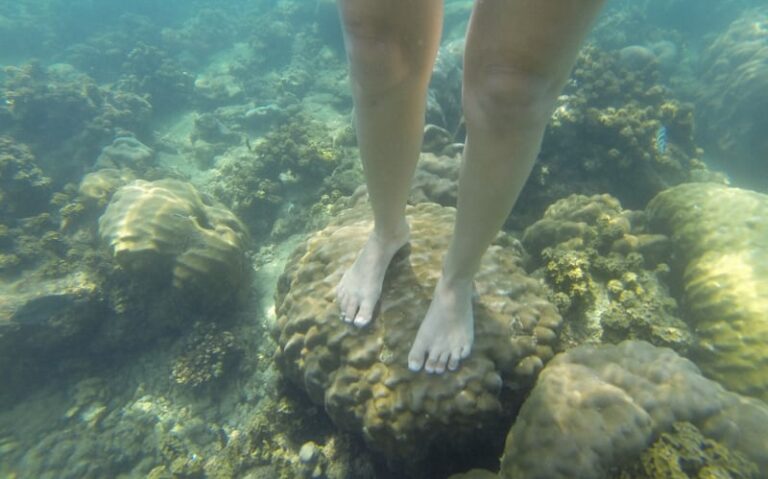
At the same time, habitats such as coral reefs, seagrass meadows, and mangrove forests experience less disturbance. As these habitats recover, they provide more food, shelter, and breeding areas for marine life.

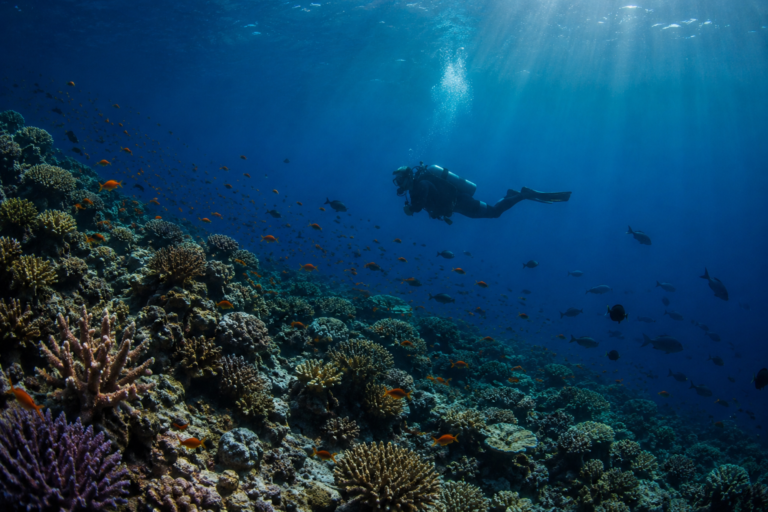
A reef with abundant fish, healthy coral, and high biodiversity is generally better able to recover after storms, disease outbreaks, or bleaching events than a reef that has already been heavily degraded.

MPAs cannot prevent these disturbances from occurring, but they can help ecosystems retain the biological capacity to recover afterwards.

These changes can lead to:

  • healthier fish populations
  • protected breeding and nursery areas
  • recovery of important habitats
  • stronger fisheries through spillover
  • greater biodiversity
  • improved ecosystem resilience
  • tourism and recreation benefits

Spillover: When Protection Benefits the Surrounding Ocean

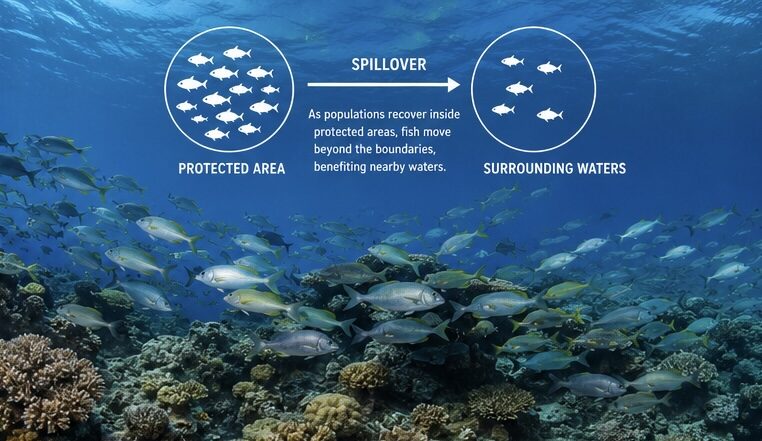
One of the most interesting effects of MPAs is spillover—the movement of marine life beyond protected boundaries.

Fish do not recognise marine park borders.

Some marine species spend their entire lives inside protected areas, while others may travel hundreds of kilometres beyond them.

As populations recover, some animals naturally move into surrounding waters. At the same time, eggs and larvae produced inside protected areas can drift with currents and settle elsewhere.

This means the benefits of protection are not always confined to the protected area itself.

In some locations, studies have found increased catches near MPA boundaries as fish populations rebuild and spread outward.

This is one reason MPAs can sometimes be controversial at first but gain support over time. Protection may reduce access in the short term, but healthier fish populations can ultimately benefit surrounding waters.

Protecting one area can help strengthen the wider ecosystem around it.

Do Marine Protected Areas Actually Work?

When MPAs are well designed, properly managed, and effectively enforced, the results can be substantial.

Cabo Pulmo National Park, Mexico

Cabo Pulmo provides one of the clearest examples of marine recovery following protection.

Before protection, decades of fishing had significantly reduced marine life throughout the area.

After fishing pressure was removed and protection strengthened, the ecosystem underwent a remarkable recovery. Over roughly a decade, the total amount of marine life increased by more than 460%, while sharks, jacks, groupers, and other large predators became far more common.

The recovery was so dramatic that an area once known for declining fish populations became a global case study in marine conservation.

Today, Cabo Pulmo is widely regarded as one of the most successful examples of marine conservation anywhere in the world, and the recovery has supported a thriving ecotourism economy for the local community.

Great Barrier Reef Marine Park, Australia

Covering approximately 344,400 square kilometres, the Great Barrier Reef Marine Park is one of the largest marine protected areas in the world.

In 2004, the proportion of the park protected as no-take zones increased from less than 5% to around 33%, creating one of the largest networks of highly protected marine areas on Earth.

Long-term monitoring has shown that many targeted fish species became significantly more abundant inside these protected zones. Coral trout, one of the reef’s most important fishery species, have often been found at roughly twice the density of nearby fished reefs.

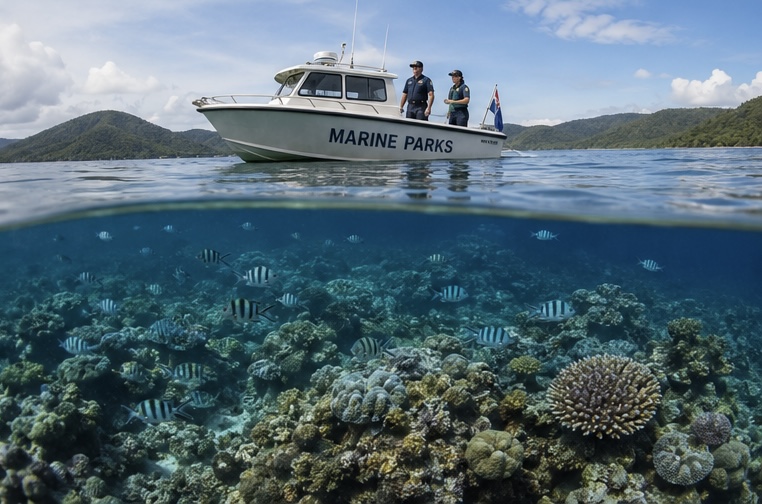
The park has also become an important example of large-scale marine zoning, balancing conservation with tourism, recreation, research, and commercial use across a vast and heavily visited ecosystem.

Why Some MPAs Work Better Than Others

Not all MPAs perform equally. Several factors strongly influence how well an MPA works:

  • Level of protection — fully protected areas tend to show the strongest ecological recovery
  • Size — larger MPAs protect more habitats and species
  • Location — protecting nursery grounds, migration routes, or biodiversity hotspots often delivers greater benefits
  • Enforcement — rules only work when they are followed
  • Time — ecosystems often need years, sometimes decades, to fully recover

Perhaps the most important factor is time.

Fish need time to grow. Corals need time to recover. Populations need time to rebuild.

Many of the most successful MPAs have been protected for decades rather than years.

Challenges and Limitations

Marine protected areas are powerful tools, but they are not a perfect solution.

Climate change, marine heatwaves, pollution, and ocean acidification can still affect protected ecosystems. An MPA can reduce local pressures, but it cannot stop global environmental change.

Protection also depends on effective management. Some MPAs exist largely on paper, with limited funding, monitoring, or enforcement.

To be effective, protected areas often require monitoring programs to track ecosystem health, patrols and compliance efforts to deter illegal activities, vessel tracking in remote regions, and habitat restoration projects where ecosystems have already been damaged.

Without these measures, protection may have little impact in practice.

For this reason, scientists generally view MPAs as one important conservation tool rather than a complete solution on their own.

Conclusion

Protecting part of an ocean is about giving ecosystems the opportunity to function, recover, and adapt in a world that is changing faster than ever.

Marine protected areas do not stop the ocean from moving—they work with that movement. By reducing pressure on key habitats and species, they help create healthier ecosystems that can support marine life far beyond their boundaries.

Their success also highlights an important lesson: given enough time and protection, marine ecosystems can recover in ways that were once thought impossible.

As pressure on the ocean continues to grow, MPAs will remain one of the most important tools for safeguarding marine ecosystems. The greatest benefits come not simply from protecting more ocean, but from ensuring that protected areas are well designed, effectively managed, and located where they can make the biggest difference.

Explore More

Scroll to Top