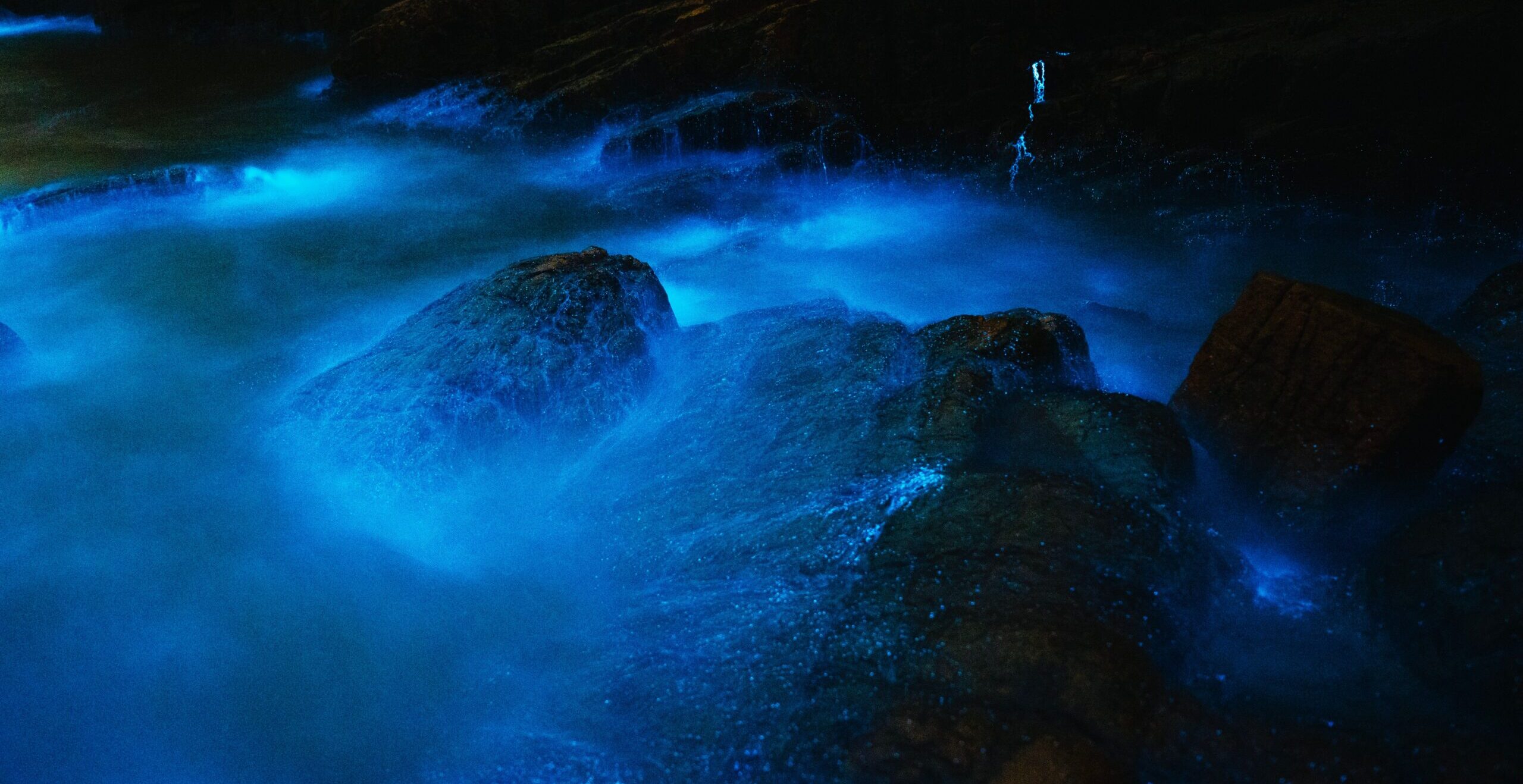
Captivating view of bioluminescent water illuminating rocks in a dark, serene setting.

Bioluminescence: Why the Ocean Glows

A flash of blue trails behind a swimming dolphin. A breaking wave lights up like liquid neon. Deep beneath the surface, a fish carries its own glowing lure through the darkness.

At first glance, bioluminescence can seem almost supernatural — as though parts of the ocean have learned to create light from nowhere. In reality, it is one of the most remarkable adaptations in nature, used by thousands of species across the marine world.

Despite being one of nature’s most spectacular phenomena, bioluminescence isn’t particularly rare. In fact, much of the ocean is alive with organisms that can produce their own light — most are simply too small, too deep, or too far offshore for us to notice.

What Is Bioluminescence?

Bioluminescence is the production of light by a living organism through a chemical reaction.

The process usually involves two key chemicals:

  • Luciferin – a light-producing molecule.
  • Luciferase – an enzyme that triggers the reaction.

When these substances react with oxygen, energy is released in the form of visible light.

Unlike a light bulb, very little energy is lost as heat. Scientists sometimes refer to this as a “cold light” because almost all of the energy goes into producing light rather than warmth.

Bioluminescence has evolved independently many times throughout Earth’s history and occurs in a wide variety of organisms, including bacteria, jellyfish, squid, crustaceans, fish, worms, and plankton.

While some land organisms such as fireflies can also glow, bioluminescence is overwhelmingly a marine phenomenon. More than three-quarters of animals living in the open ocean are thought to use bioluminescence in some way.

Why Is Bioluminescence So Common in the Ocean?

The answer lies in darkness.

Sunlight only penetrates the upper layer of the ocean. Beyond a few hundred metres, light rapidly fades. By around 1,000 metres, the ocean is in a zone of near-total darkness.

In an environment where visibility is limited, the ability to produce light can provide a major advantage.

Many deep-sea animals use bioluminescence for the same reasons humans use torches, signals, and camouflage. Light can help them find food, locate mates, communicate, or avoid predators.

Over millions of years, these advantages have made bioluminescence one of the most successful survival strategies in the ocean.

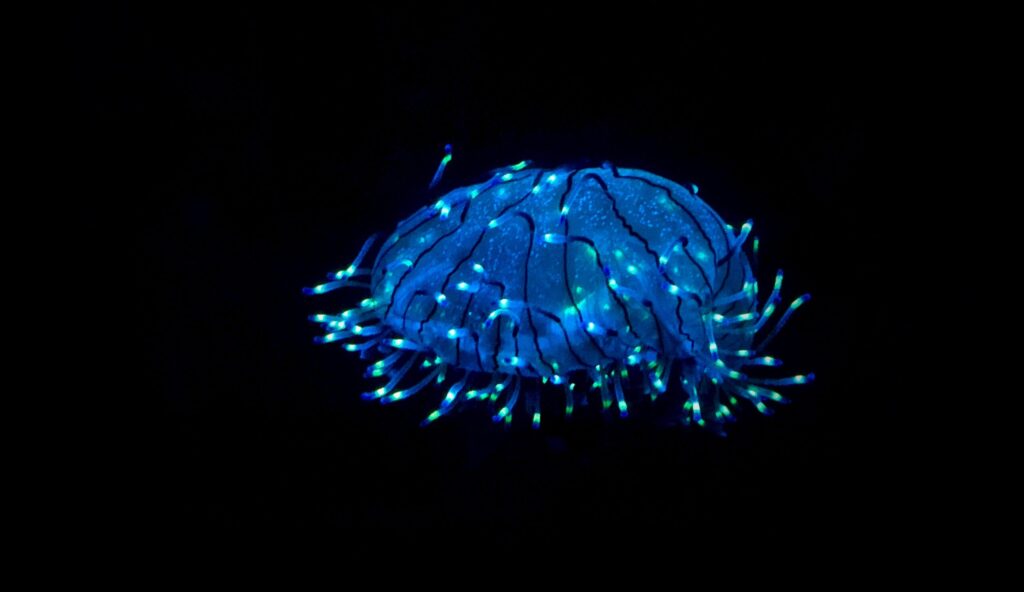
A mesmerizing blue bioluminescent jellyfish glowing against a black background underwater.

How Animals Use Bioluminescence

Different species use bioluminescence in surprisingly different ways.

Attracting Prey

One of the most famous examples is the anglerfish.

Living in the deep sea, female anglerfish possess a glowing lure that hangs in front of their mouths. Small fish and crustaceans are attracted to the light, mistaking it for food or safety. When they get close enough, the anglerfish strikes.

It’s essentially a fishing rod built into the fish itself.

Avoiding Predators

Not all bioluminescence is used for hunting.

Many small animals use light as a defence mechanism.

Some species of squid and shrimp can release glowing clouds into the water when threatened. The bright burst can startle predators or create a distraction, allowing the animal to escape while the predator investigates the glowing cloud.

Others use sudden flashes of light to confuse attackers in the same way a camera flash might temporarily affect your vision.

Hiding in Plain Sight

Some animals use bioluminescence not to stand out, but to disappear.

Species such as lanternfish, squid, and some sharks produce light from their undersides to match the faint sunlight filtering down from above. This helps conceal their silhouette from animals looking up from below — a form of camouflage known as counter-illumination.

The cookiecutter shark takes this strategy a step further. Scientists believe a dark, non-glowing patch on its throat may resemble a small fish, attracting larger animals close enough for the shark to take a bite. Despite reaching only around 50 centimetres long, cookiecutter sharks have been found leaving distinctive circular wounds on whales, dolphins, tuna, and even other sharks.

Finding a Mate

In the darkness of the deep sea, simply locating another member of your species can be difficult.

Many animals produce species-specific light patterns that help potential mates identify one another. Some deep-sea fish and squid even have glowing organs arranged in unique patterns, almost like biological identification signals.

Communicating

Bioluminescence can also be used to send messages.

Scientists believe some species use flashes or patterns of light to communicate with members of their own species, although much about these behaviours remains poorly understood.

In the deep ocean, where sound and sight are often limited, a flash of light can carry important information.

The Ocean’s Most Spectacular Light Show

For many people, the most memorable encounter with bioluminescence doesn’t happen in the deep sea.

It happens at the beach.

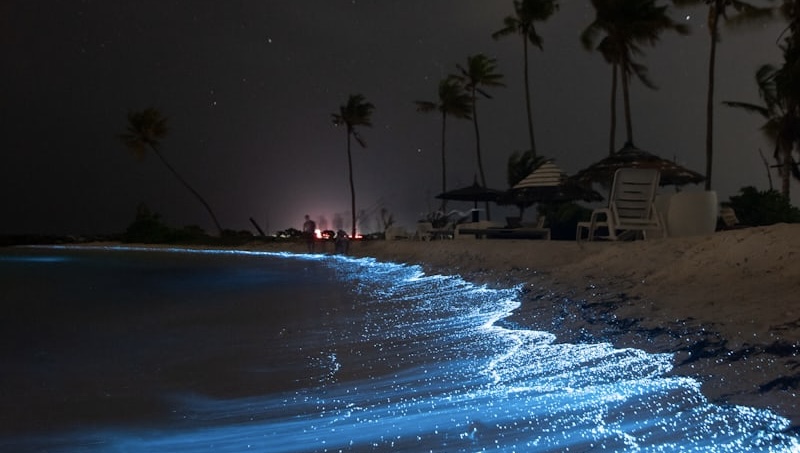
Certain species of microscopic plankton called dinoflagellates can produce bright blue flashes when disturbed. When waves break, fish swim, or paddles move through the water, millions of these tiny organisms can light up simultaneously.

The result can look as though someone has poured liquid stars into the sea. Every breaking wave, swimming fish, or splash of a paddle leaves a trail of electric-blue light across the water.

Bioluminescent dinoflagellate blooms occur in many parts of the world, including places such as Jervis Bay in Australia, Mosquito Bay in Puerto Rico, and Tomales Bay in California. They tend to appear when conditions are favourable, including suitable water temperatures, calm seas, and enough nutrients in the water.

Because each organism is microscopic, the glow is only visible when enormous numbers gather together. A beach that glows brilliantly one night may show little or no bioluminescence a few days later if the bloom disperses.

Scientists believe this flashing behaviour may help deter predators. A fish attempting to feed on the plankton creates a burst of light, potentially attracting larger predators that might then target the fish instead.

What looks beautiful to us may actually be part of a microscopic survival strategy.

Do All Bioluminescent Animals Create Their Own Light?

Not always.

Some species produce light themselves through chemical reactions within specialised organs.

Others rely on glowing bacteria that live inside their bodies.

Certain squid and fish maintain colonies of bioluminescent bacteria in dedicated light organs. The bacteria receive a safe place to live and nutrients, while the host animal gains the ability to glow.

This partnership allows some animals to control when and how much light is produced.

The Hidden World Beneath Us

Bioluminescence reminds us that much of the ocean remains unfamiliar.

Every night, countless organisms are flashing, glowing, signalling, hunting, and hiding beneath the surface. Entire ecosystems communicate using light in ways scientists are still trying to understand.

Most of us only glimpse bioluminescence during a rare glowing wave, an unforgettable night paddle, or a video on the internet. Yet far offshore and deep below, some of the ocean’s most extraordinary displays are happening, hidden from view.

The ocean doesn’t just reflect light from the sun. In many places, it creates its own.

Explore More

Scroll to Top