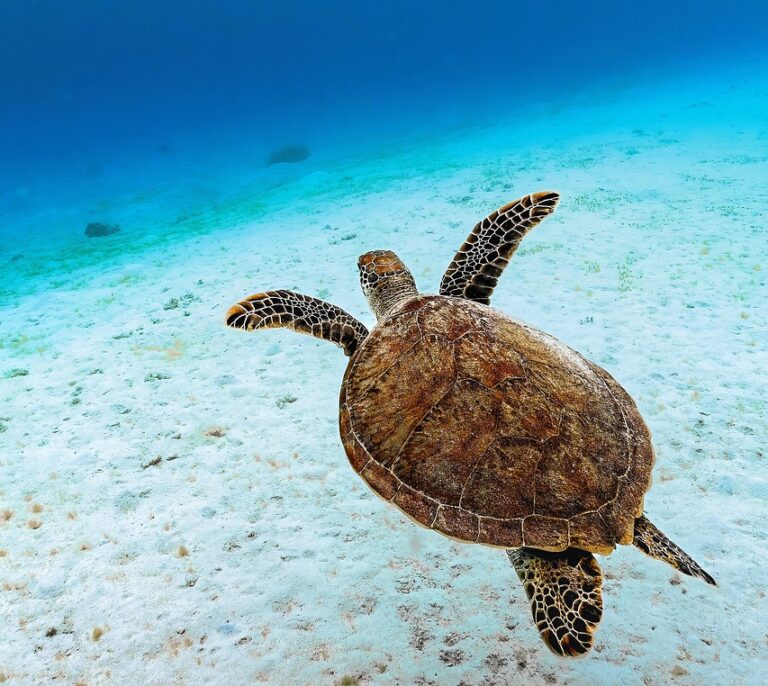
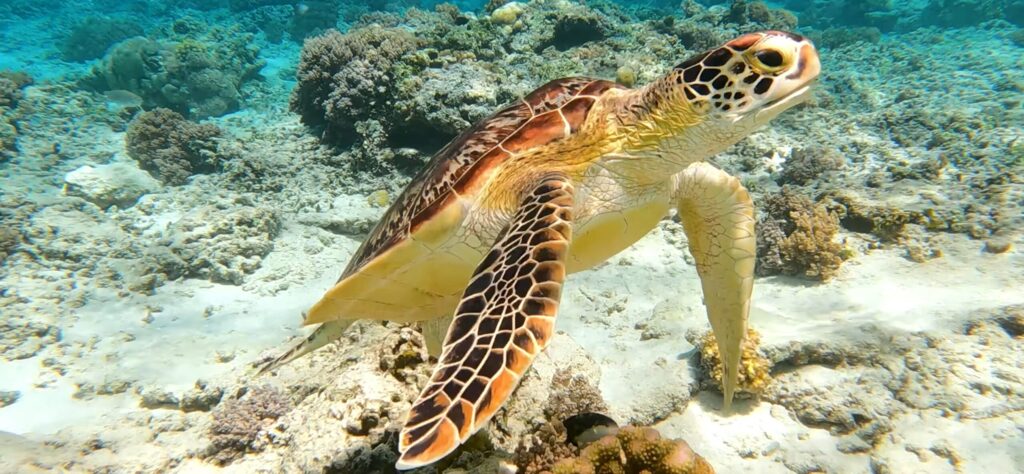
Ask someone to picture a sea turtle and they’re probably imagining a green sea turtle gliding over a coral reef.
It’s an image that appears in documentaries, tourism campaigns, and conservation messaging. Because of that familiarity, it’s easy to assume all sea turtles are essentially the same.
In reality, seven species of sea turtle inhabit the world’s oceans. Some can grow large enough to weigh more than 700 kilograms, roam entire oceans, or almost exclusively inhabit Australian waters.
They share ancient origins, yet each species has evolved its own appearance, distribution, and way of life.
What Makes a Sea Turtle a Sea Turtle?
Sea turtles are reptiles, meaning they breathe air, are cold-blooded, and lay eggs on land.
Unlike freshwater turtles and tortoises, they are highly adapted for life at sea. Their limbs have evolved into powerful flippers, their bodies are streamlined for efficient swimming, and they can spend hours underwater between breaths.
Although turtles are often imagined as slow-moving animals, sea turtles can be surprisingly fast when they need to be. A turtle resting on a reef may appear calm and unhurried, yet with a few powerful strokes it can vanish into open water in a split second.
The seven living species are found throughout tropical, subtropical, and temperate oceans worldwide. Six belong to the same scientific family, while the leatherback is so distinct that it belongs to a family of its own.
Green Sea Turtle
Chelonia mydas
Conservation status: Endangered (IUCN)
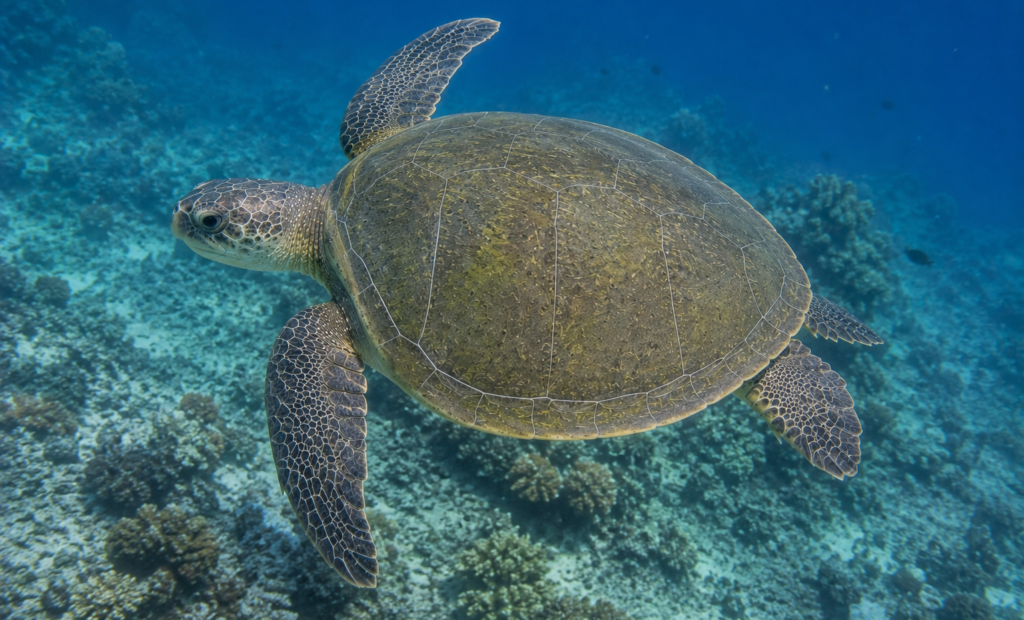
With their smooth shell, rounded face, and calm appearance, green turtles embody what many people imagine when they think of a sea turtle. Large adults can exceed one metre in shell length and weigh more than 180 kilograms.
Their oval-shaped shell is coloured in shades of olive, brown, and grey, often with beautiful marbled patterns. Despite the name, the shell itself is rarely green. Instead, the species takes its name from the greenish colour of its body fat!
Green turtles typically have four pairs of scutes — the hexagon-like shapes — on each side of the shell’s central row; a feature often used to distinguish them from other species.
Hawksbill Sea Turtle
Eretmochelys imbricata
Conservation status: Critically Endangered (IUCN)
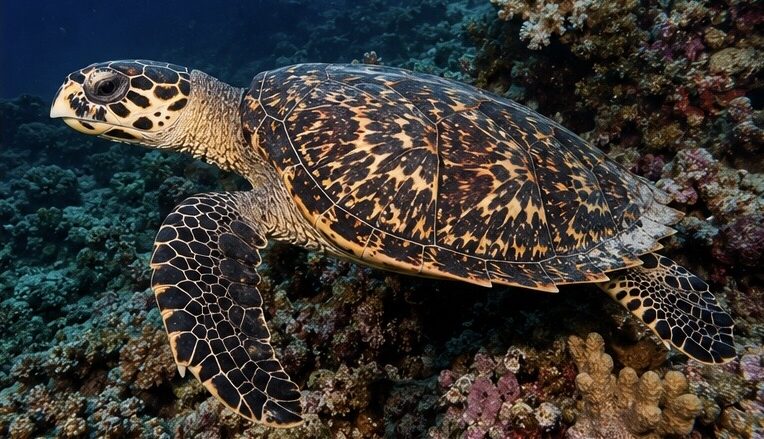
If sea turtles had a species most likely to stop people in their tracks, the hawksbill would be a strong contender.
Its shell is covered in rich amber, gold, brown, and black patterns that catch the light in striking ways.
The easiest way to identify a hawksbill is by its sharp, bird-like beak and the serrated edge of its shell.
Loggerhead Sea Turtle
Caretta caretta
Conservation status: Vulnerable (IUCN)
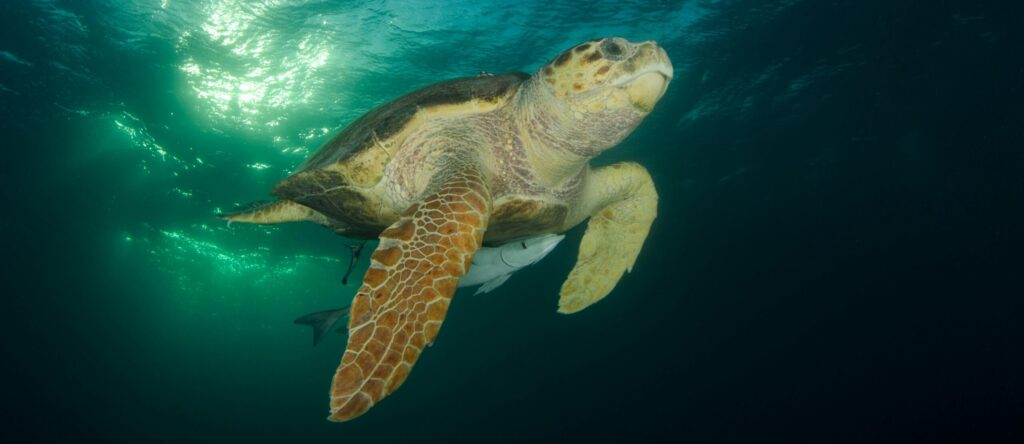
The loggerhead is named for its most obvious feature: its enormous head.
Compared with other sea turtles, loggerheads have a broader face, thicker neck, and heavier build. While hawksbills appear elegant and green turtles appear graceful, loggerheads often look sturdier and more rugged.
Their shells are usually reddish-brown or orange-brown, while the head and flippers often have a warm golden colour.
Loggerheads are found throughout the world’s oceans and can grow to impressive sizes, with large individuals weighing well over 100 kilograms.
Leatherback Sea Turtle
Dermochelys coriacea
Conservation status: Vulnerable (IUCN)
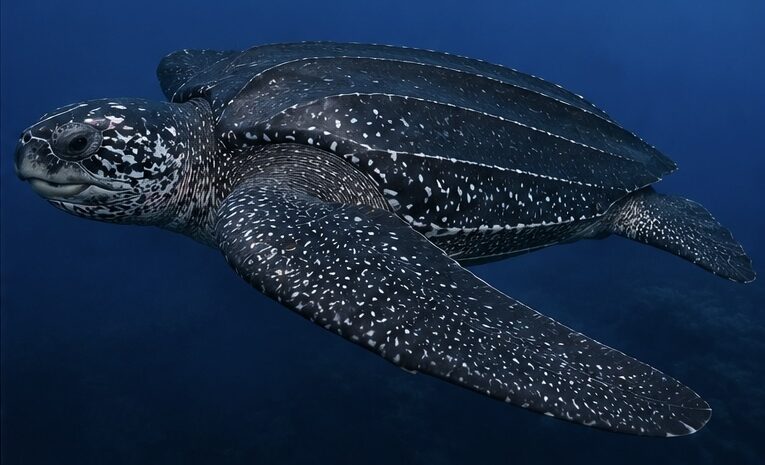
The leatherback looks less like a typical sea turtle and more like something from another era.
It is the largest sea turtle on Earth and by far the most distinctive. Some individuals exceed two metres in length and weigh more than 700 kilograms.
Unlike all other sea turtles, leatherbacks do not have a hard shell covered in scutes. Instead, their backs are covered by thick, leathery skin with seven raised ridges running from front to back.
Once you’ve seen a leatherback, you’ll never mistake it for another species. Its size, shape, and dark colouration give it a prehistoric appearance that hints at the ancient origins of sea turtles.
Flatback Sea Turtle
Natator depressus
Conservation status: Endangered (IUCN)
The flatback is Australia’s unique sea turtle.
Unlike the other six species, which occur across multiple oceanic regions, flatbacks are found almost exclusively in Australian and nearby waters.
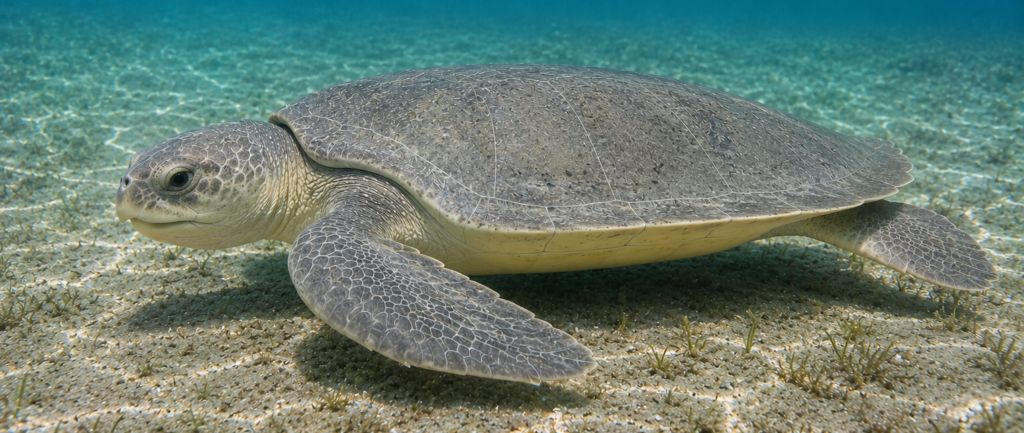
As the name suggests, they have a noticeably flatter shell than other sea turtles. Their shell is also relatively smooth, with gently upturned edges that contribute to their distinctive shape.
Flatbacks are often grey-green or olive in colour. They tend to forage in shallow coastal waters and are generally less well known than their more widespread relatives.
Their limited distribution makes them one of the least familiar sea turtle species globally.
Olive Ridley Sea Turtle
Lepidochelys olivacea
Conservation status: Vulnerable (IUCN)
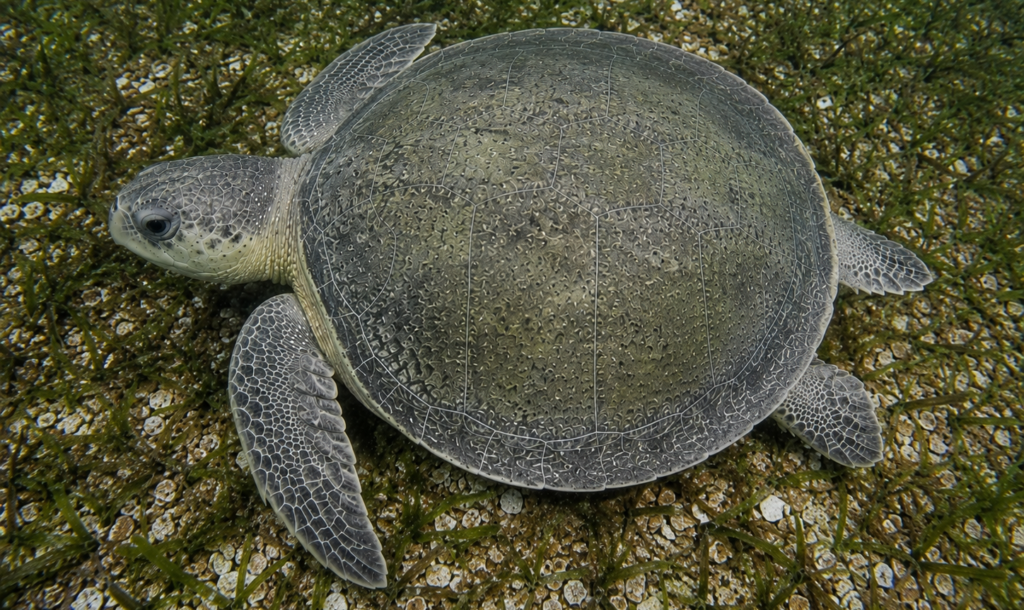
The olive ridley is one of the smaller sea turtle species and is named after the olive-green colour of its shell.
Compared with species such as green turtles and loggerheads, olive ridleys have a rounder, more compact appearance. When viewed from above, their shell appears almost circular.
Although smaller than many of their relatives, olive ridleys are found throughout tropical regions of the Pacific, Indian, and Atlantic Oceans.
They are particularly famous for their extraordinary mass nesting events, known as arribadas, where thousands of females come ashore to nest on the same beach over just a few days.
Kemp’s Ridley Sea Turtle
Lepidochelys kempii
Conservation status: Critically Endangered (IUCN)
The Kemp’s ridley is the smallest sea turtle species in the world.
Adults are typically only around 60 to 70 centimetres long. A large leatherback can outweigh a Kemp’s ridley by more than ten times.
Like the olive ridley, they possess a relatively round shell, though they are generally more compact in overall appearance.
Their distribution is much more restricted than most sea turtles, with the majority occurring in and around the Gulf of Mexico. Kemp’s ridleys are also known for their own arribada-style nesting events, though on a smaller scale than the olive ridley.
Small though they may be, Kemp’s ridleys remain remarkable travellers, capable of long-distance movements across the Gulf and western Atlantic.
Seven Quick Turtle Facts
- Largest species: Leatherback sea turtle
- Smallest species: Kemp’s ridley sea turtle
- Most commonly encountered by snorkellers: Green sea turtle
- Most distinctive beak: Hawksbill sea turtle
- Largest head: Loggerhead sea turtle
- Only species found almost exclusively in Australia: Flatback sea turtle
- Famous for mass nesting events: Olive ridley sea turtle
A Survivor From Another Age
Long before humans appeared, before whales evolved, and before modern coral reefs took shape, the ancestors of today’s sea turtles were already swimming through ancient oceans.
Over millions of years, continents shifted, climates changed, and countless species disappeared. Yet sea turtles endured, evolving into the seven species we know today.
Each species represents a different path through that history. Some became giants capable of crossing entire oceans. Others evolved specialised shapes, behaviours, and lifestyles suited to particular habitats.
Together, they are a reminder that even among the ocean’s most familiar animals, there is often far more diversity than first meets the eye.